



The Vishera Review: AMD FX-8350, FX-8320, FX-6300 and FX-4300 Tested
by Anand Lal Shimpi on October 23, 2012 12:00 AM ESTLast year's launch of AMD's FX processors was honestly disappointing. The Bulldozer CPU cores that were bundled into each Zambezi chip were hardly power efficient and in many areas couldn't significantly outperform AMD's previous generation platform. Look beyond the direct AMD comparison and the situation looked even worse. In our conclusion to last year's FX-8150 review I wrote the following:
"Single threaded performance is my biggest concern, and compared to Sandy Bridge there's a good 40-50% advantage the i5 2500K enjoys over the FX-8150. My hope is that future derivatives of the FX processor (perhaps based on Piledriver) will boast much more aggressive Turbo Core frequencies, which would do wonders at eating into that advantage."
The performance advantage that Intel enjoyed at the time was beyond what could be erased by a single generation. To make matters worse, before AMD could rev Bulldozer, Intel already began shipping Ivy Bridge - a part that not only increased performance but decreased power consumption as well. It's been a rough road for AMD over these past few years, but you have to give credit where it's due: we haven't seen AMD executing this consistently in quite a while. As promised we've now had multiple generations of each platform ship from AMD. Brazos had a mild update, Llano paved the way for Trinity which is now shipping, and around a year after Zambezi's launch we have Vishera: the Piledriver based AMD FX successor.
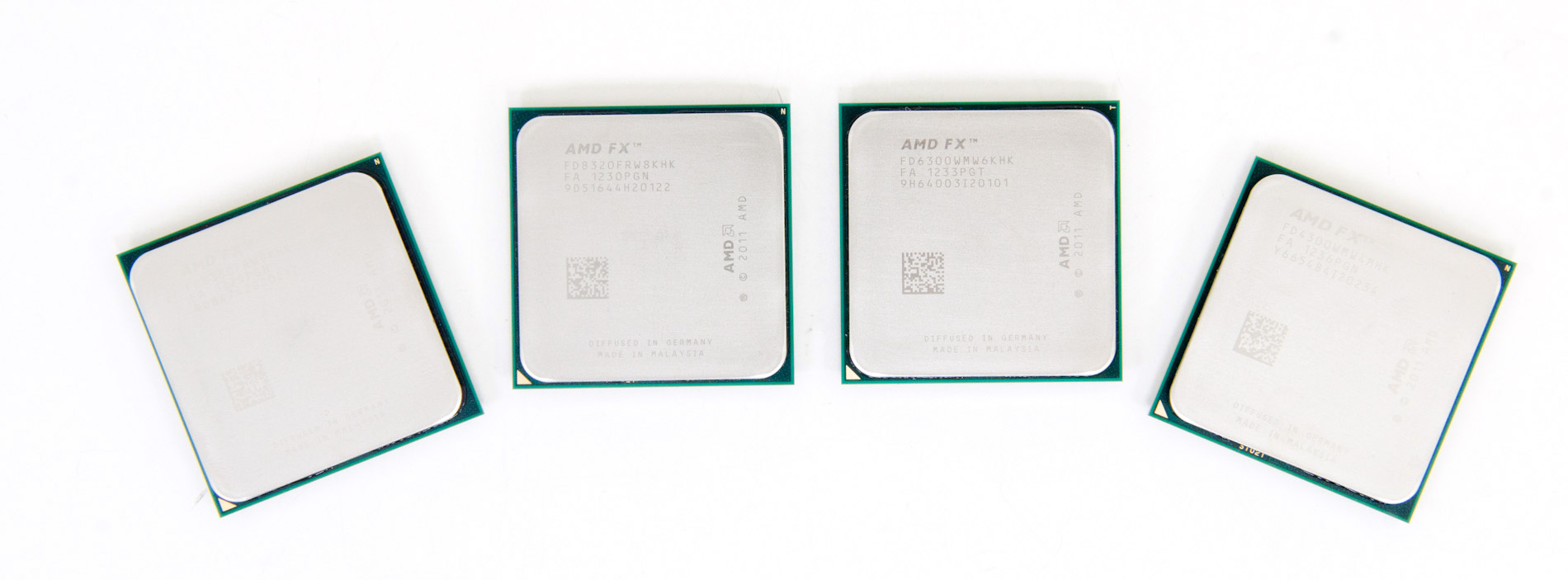
At a high level, Vishera swaps out the Bulldozer cores from Zambezi and replaces them with Piledriver. This is the same CPU core that is used in Trinity, but it's optimized for a very different purpose here in Vishera. While Trinity had to worry about working nicely in a laptop, Vishera is strictly a high-end desktop/workstation part. There's no on-die graphics for starters. Clock speeds and TDPs are also up compared to Trinity.
| CPU Specification Comparison | ||||||||
| CPU | Manufacturing Process | Cores | Transistor Count | Die Size | ||||
| AMD Vishera 8C | 32nm | 8 | 1.2B | 315mm2 | ||||
| AMD Zambezi 8C | 32nm | 8 | 1.2B | 315mm2 | ||||
| Intel Ivy Bridge 4C | 22nm | 4 | 1.4B | 160mm2 | ||||
| Intel Sandy Bridge E (6C) | 32nm | 6 | 2.27B | 435mm2 | ||||
| Intel Sandy Bridge E (4C) | 32nm | 4 | 1.27B | 294mm2 | ||||
| Intel Sandy Bridge 4C | 32nm | 4 | 1.16B | 216mm2 | ||||
| Intel Lynnfield 4C | 45nm | 4 | 774M | 296mm2 | ||||
| Intel Sandy Bridge 2C (GT1) | 32nm | 2 | 504M | 131mm2 | ||||
| Intel Sandy Bridge 2C (GT2) | 32nm | 2 | 624M | 149mm2 | ||||
Vishera is still built on the same 32nm GlobalFoundries SOI process as Zambezi, which means there isn't much room for additional architectural complexity without ballooning die area, and not a whole lot of hope for significantly decreasing power consumption. As a fabless semiconductor manufacturer, AMD is now at GF's mercy when it comes to moving process technology forward. It simply has to make 32nm work for now. Piledriver is a light evolution over Bulldozer, so there's actually no substantial increase in die area compared to the previous generation. Cache sizes remain the same as well, which keeps everything roughly the same. These chips are obviously much larger than Intel's 22nm Ivy Bridge parts, but Intel has a full node advantage there which enables that.
Piledriver is a bit more power efficient than Bulldozer, which enables AMD to drive Vishera's frequency up while remaining in the same thermal envelope as Zambezi. The new lineup is in the table below:
| CPU Specification Comparison | ||||||||||
| Processor | Codename | Cores | Clock Speed | Max Turbo | L2/L3 Cache | TDP | Price | |||
| AMD FX-8350 | Vishera | 8 | 4.0GHz | 4.2GHz | 8MB/8MB | 125W | $199 | |||
| AMD FX-8150 | Zambezi | 8 | 3.6GHz | 4.2GHz | 8MB/8MB | 125W | $183 | |||
| AMD FX-8320 | Vishera | 8 | 3.5GHz | 4.0GHz | 8MB/8MB | 125W | $169 | |||
| AMD FX-8120 | Zambezi | 8 | 3.1GHz | 4.0GHz | 8MB/8MB | 125W | $153 | |||
| AMD FX-6300 | Vishera | 6 | 3.5GHz | 4.1GHz | 6MB/8MB | 95W | $132 | |||
| AMD FX-6100 | Zambezi | 6 | 3.3GHz | 3.9GHz | 6MB/8MB | 95W | $112 | |||
| AMD FX-4300 | Vishera | 4 | 3.8GHz | 4.0GHz | 4MB/4MB | 95W | $122 | |||
| AMD FX-4100 | Zambezi | 4 | 3.6GHz | 3.8GHz | 4MB/4MB | 95W | $101 | |||
The table above says it all. TDPs haven't changed, cache sizes haven't changed and neither have core counts. Across the board Vishera ships at higher base frequencies than the equivalent Zambezi part, but without increasing max turbo frequency (in the case of the 8-core parts). The 6 and 4 core versions get boosts to both sides, without increasing TDP. In our Trinity notebook review I called the new CPU core Bulldozed Tuned. The table above supports that characterization.
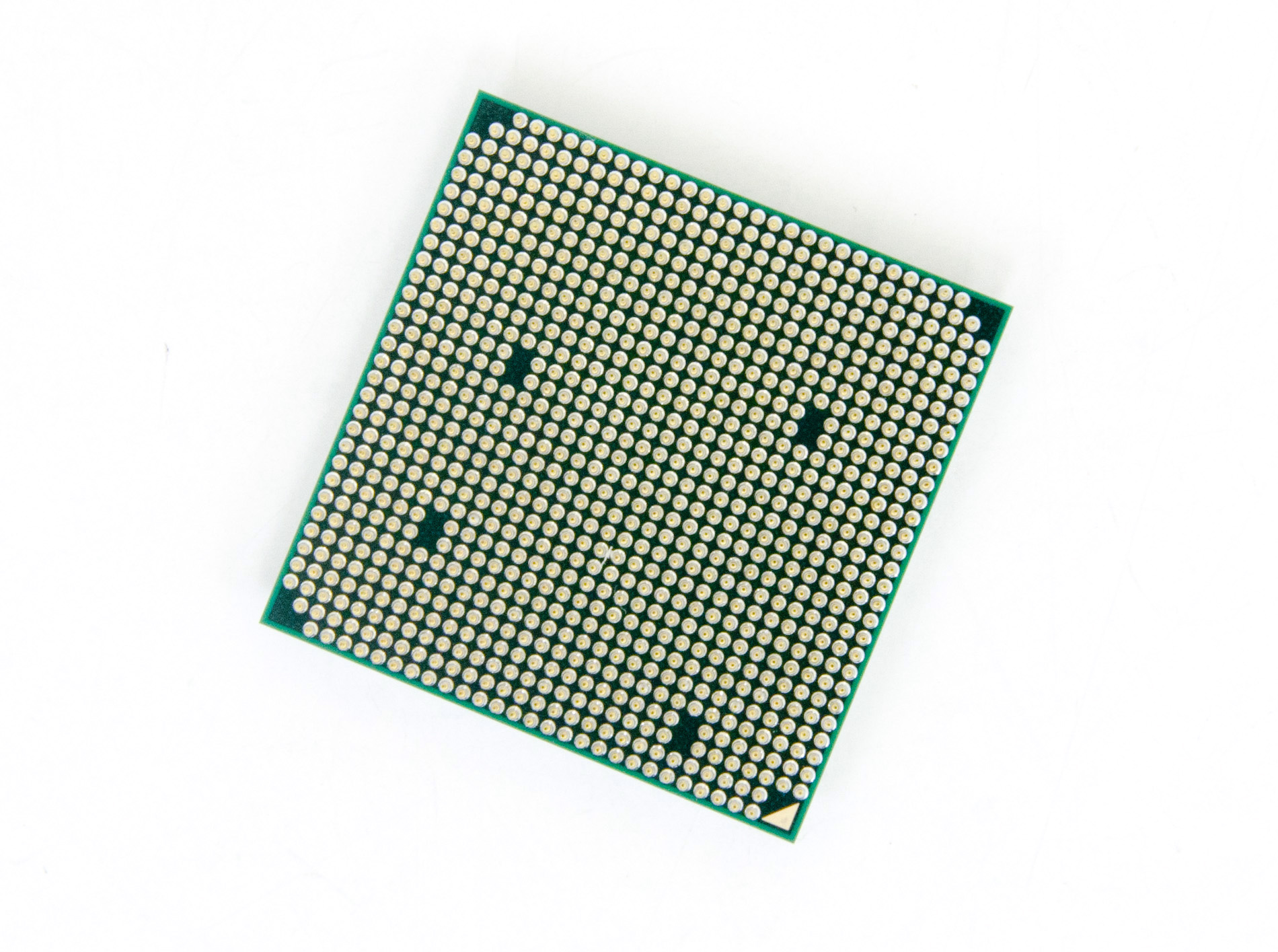
It's also important to note that AMD's pricing this time around is far more sensible. While the FX-8150 debuted at $245, the 8350 drops that price to $199 putting it around $40 less than the Core i5 3570K. The chart below shows where AMD expects all of these CPUs to do battle:
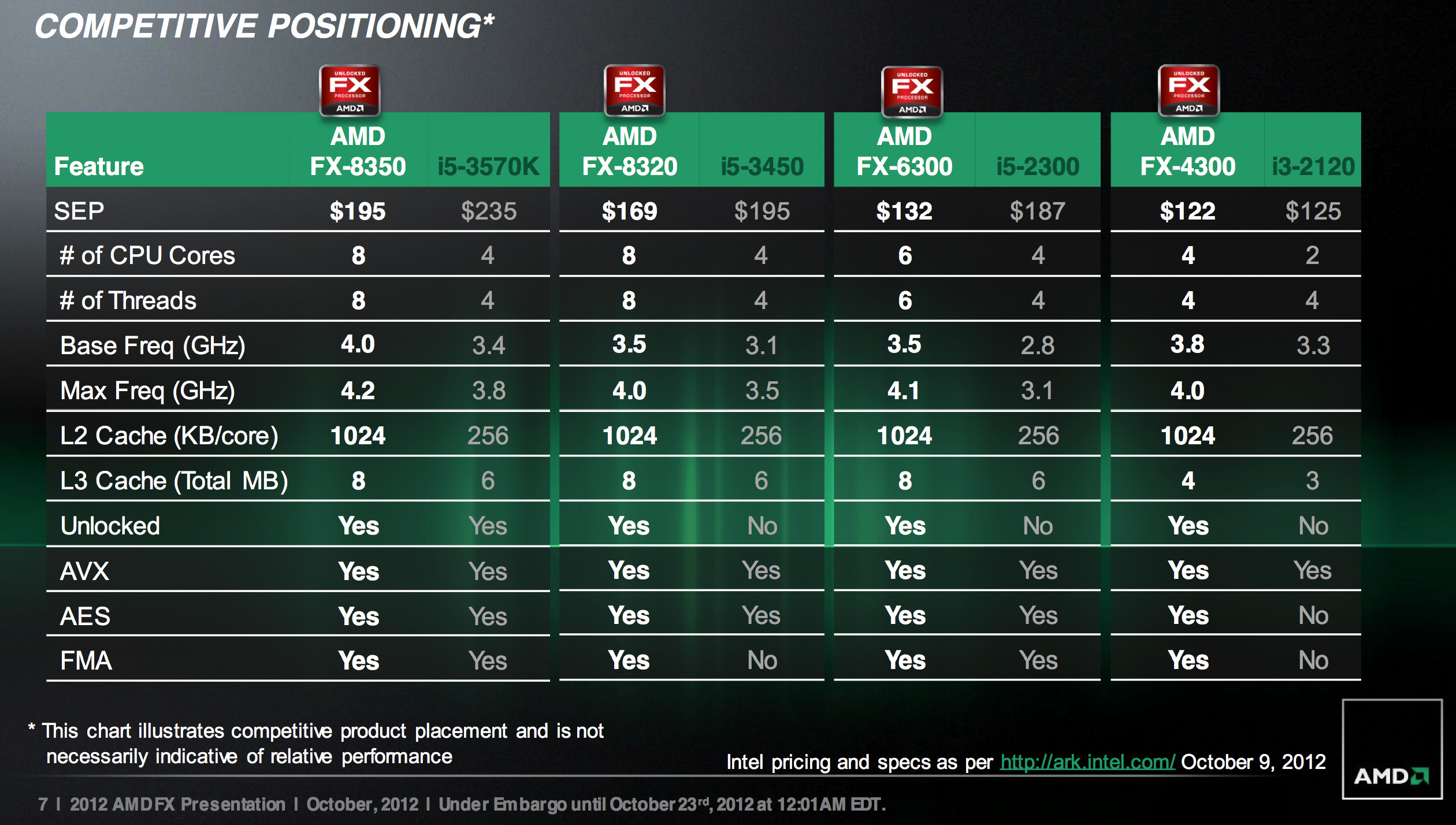
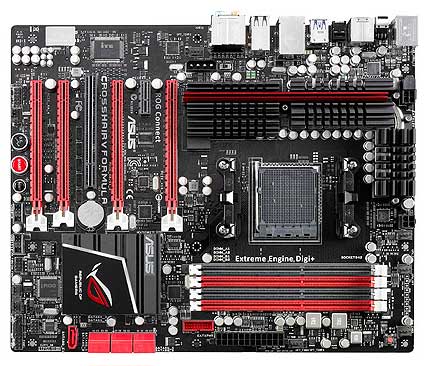
AMD's targets are similar to what they were last time: Intel's Core i5 and below. All of the FX processors remain unlocked and ship fully featured with hardware AES acceleration enabled. Most Socket-AM3+ motherboards on the market today should support the new parts with nothing more than a BIOS update. In fact, I used the same ASUS Crosshair V Formula motherboard I used last year (with a much newer BIOS) for today's review:
The Test
For more comparisons be sure to check out our performance database: Bench.
| Motherboard: | ASUS Maximus V Gene (Intel Z77) ASUS Crosshair V Formula (AMD 990FX) |
| Hard Disk: | Intel X25-M SSD (80GB) Crucial RealSSD C300 OCZ Agility 3 (240GB) Samsung SSD 830 (512GB) |
| Memory: | 4 x 4GB G.Skill Ripjaws X DDR3-1600 9-9-9-20 |
| Video Card: | ATI Radeon HD 5870 (Windows 7) NVIDIA GeForce GTX 680 (Windows 8) |
| Desktop Resolution: | 1920 x 1200 |
| OS: | Windows 7 x64/Windows 8 Pro x64 |


 Facebook
 Twitter
 RSS
RSS


250 Comments
View All Comments
Operandi - Tuesday, October 23, 2012 - link
Looks like Piledriver delivered. Granted the bar was set pretty low with Bulldozer but this at least has a use case, highly threaded applications but considering this is a process node behind Intel I’d say its pretty good. If they can keep this pace up and hit IPC a bit harder AMD could be back in a pretty good position.silverblue - Tuesday, October 23, 2012 - link
At least now they can say they beat Intel in a lot of multithreaded situations. Losing to Intel AND using more power was unpalatable. I'd like to see an undervolted 8350, perhaps AMD's conservative side is rearing its ugly head again.I'm a bit concerned that, even with hard-edge flops and the RCM, the clock speed difference is about 11% for the same power. I'd have thought that even the former would shave off a decent amount, unless RCM doesn't work so well at higher speeds. Still, there's one disadvantage to be had - overclocking won't work so well due to the flop change.
If AMD can beat Intel now in multithreading in most circumstances, Steamroller is just going to let them pull away. Single-threaded workloads are the worry, though. Still, at least they can say that they finally beat Nehalem even in single-threaded work. I did lament the lack of an appearance of Phenom II, but looking at the results, they've buried that particular ghost.
Finally - Tuesday, October 23, 2012 - link
Undervolting, you said?Here you go: http://www.computerbase.de/artikel/prozessoren/201...
Spunjji - Tuesday, October 23, 2012 - link
Thanks! +1 to that.CeriseCogburn - Tuesday, October 30, 2012 - link
ROFL, thank you the 3 stooges.I'd like to particularly thank silverblue the little co amd fanboy who provided immense entertainment in that they lost, then moments later, they won, deranged fantasy spew. Good to know Stearoller is going to "pull away" !
hahahahhahahahahha
One for all and amd all won !
LOL
rkrb79 - Friday, October 10, 2014 - link
FYI I joined Anandtech just so I could tell you that you are a douchebag!!Taft12 - Tuesday, October 23, 2012 - link
+2 in fact!An official lower-TDP version version of the 8-core CPU would be very nice. 95W or even lower as Intel does with their -S SKUs.
At my workplace, the i7-3770S has been just plain outstanding for our small form-factor server/workstation appliance that travels to tradeshows with our sales guys. I'd happily trial an AMD 8-core equivalent.
silverblue - Wednesday, October 24, 2012 - link
Happy to +3 you on that. :)CeriseCogburn - Tuesday, October 30, 2012 - link
- 10 for the once again PATHETIC HACKING that is required for amd to be acceptable.(that's minus ten !)
LOL - fan boy fan joy fan toy EPIC FAIL !
StevoLincolnite - Tuesday, October 23, 2012 - link
I wouldn't say it has delivered. Not yet anyway.Remember the Phenom 2's IPC is lower than the later model Core 2's and Piledriver still needs 700mhz+ to beat a Phenom 2, so that puts it in perspective.
Mind you, overclock the NB on a Phenom 2 and you can get some pretty interesting gains in the range of 5-15% depending on the situation.
However, like AMD has done for the last several years, they are happy to throw more cores at the performance problem, which is great, we just wish those cores were a little beefier or software to become more heavily threaded.
The other flip-side is this will drop straight into some AM3 motherboards and all AM3+ motherboards, so it's a worthy upgrade if you're running something like an Athlon, plus it's cheap.
But the consensus is that if you're still running a Phenom 2 x6, and you don't need 8-threads and mostly play video games, it really is throwing money into the fire in order to upgrade to the FX line, Piledriver or not, unless you intend to overclock the chips to 4.8ghz+ which the Phenom 2's can't reach on air.