



NVIDIA’s GeForce GT 220: 40nm and DX10.1 for the Low-End
by Ryan Smith on October 12, 2009 6:00 AM EST- Posted in
- GPUs
There are some things you just don’t talk about among polite company. Politics, money, and apparently OEM-only GPUs. Back in July NVIDIA launched their first 40nm GPUs, and their first GPUs featuring DX10.1 support; these were the GeForce GT 220 and G 210. And if you blinked, you probably missed it. As OEM-only parts, these went into the OEM channel without any fanfare or pageantry.
Today that changes. NVIDIA is moving the GT 220 and G 210 from OEM-only sales to retail, which means NVIDIA’s retail vendors can finally get in on the act and begin selling cards. Today we are looking at one of the first of those cards, the Palit GT 220 Sonic Edition.
| Form Factor | 9600GT | 9600GSO | GT 220 (GDDR3) | 9500GT | G 210 (DDR2) |
| Stream Processors | 64 | 48 | 48 | 32 | 16 |
| Texture Address / Filtering | 32 / 32 | 24 / 24 | 16 / 16 | 16 / 16 | 16 / 16 |
| ROPs | 16 | 16 | 8 | 8 | 8 |
| Core Clock | 650MHz | 600MHz | 625MHz | 550MHz | 675MHz |
| Shader Clock | 1625MHz | 1500MHz | 1360MHz | 1400MHz | 1450MHz |
| Memory Clock | 900MHz | 900MHz | 900MHz | 400MHz |
400MHz |
| Memory Bus Width | 256-bit | 128-bit | 128-bit | 128-bit | 64-bit |
| Frame Buffer | 512MB | 512MB | 512MB | 512MB | 512MB |
| Transistor Count | 505M | 505M | 486M | 314M | 260M |
| Manufacturing Process | TSMC 55nm | TSMC 55nm | TSMC 40nm | TSMC 55nm | TSMC 40nm |
| Price Point | $69-$85 | $40-$60 | $69-$79 | $45-$60 | $40-$50 |
GT 220 and G 210 are based on the GT216 and GT218 cores respectively (anyone confused yet?) which are the first and so far only 40nm members of NVIDIA’s GT200 family. These are specifically designed as low-end cards, with 48 SPs on the GT 220, and 16 SPs on the G 210. The GT 220 is designed to sit between the 9500GT and 9600GT in performance, making its closest competitor the 48SP 9600GSO. Meanwhile the G 210 is the replacement for the 9400GT.
We will see multiple configurations for each card, as NVIDIA handles low-end parts somewhat looser than they do the high-end parts. GT 220 will come with DDR2, DDR3, or GDDR3 memory on a 128bit bus, with 512MB or 1GB of it. So the memory bandwidth of these cards is going to vary wildly; the DDR2 cards will be 400MHz and the GDDR3 cards may go as high as 1012MHz according to NVIDIA’s specs. G 210 meanwhile will be DDR2 and DDR3 only, again going up to 1GB. With a 64bit memory bus, it will have half the memory bandwidth of GT 220.
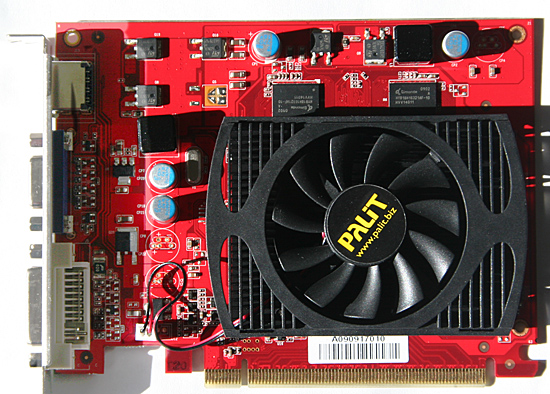
The GPU configurations will vary too, but not as wildly. NVIDIA’s official specs call for a 625MHz core clock and a 1360MHz shader clock. We’ve seen a number of cards with a higher core clock, and a card with a lower shader clock. Based on the card we have, we’re going to consider 635Mhz/1360Mhz stock for the GPU, and 900MHz stock for GDDR3, and test accordingly.
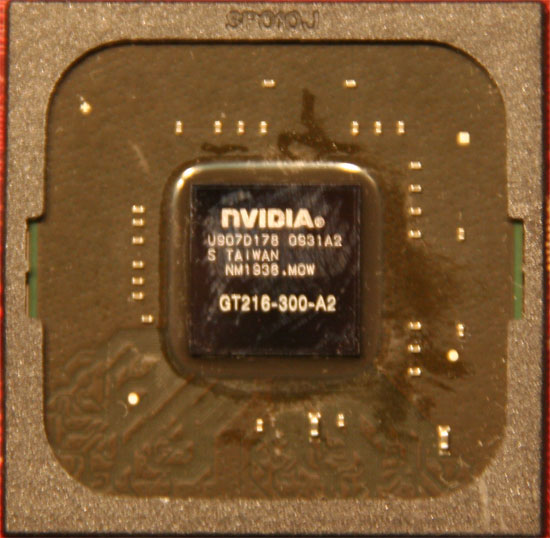
The transistor count for the GT218 die comes out to 260M, and for GT216 it’s 486M. NVIDIA would not disclose the die size to us, but having disassembled our GT 220, we estimate it to be around 100mm2. One thing we do know for sure is that along with the small die, NVIDIA has managed to knock down power consumption for the GT 220. At load the card will draw 58W, at idle it’s a tiny 7W. We don’t have the power data for the G 210, but it’s undoubtedly lower.
The prices on GT 220 cards are expected to range between $69 and $79, with the cards at the top end being those with the best RAM. This puts GT 220 in competition with AMD’s Radeon HD 4600 series, and NVIDIA’s own 9600GT. The G 210 will have an approximate price of $45, putting it in range of the Radeon HD 4300/4500 series, and NVIDIA’s 9500GT. The GT 220 in particular is in an odd spot: it’s supposed to underperform the equally priced (if not slightly cheaper) 9600GT. Meanwhile the G210 is supposed to underperform the 9500GT, which is also available for $45. So NVIDIA is already starting off on the wrong foot here.
Finally, availability should not be an issue. These cards have been shipping for months to OEMs, so the only thing that has really changed is that now some of them are going into the retail pool. It’s a hard launch and then some. Not that you’ll see NVIDIA celebrating; while the OEM-only launch was no-key, this launch is only low-key at best. NVIDIA didn’t send out any samples, and it wasn’t until a few days ago that we had the full technical data on these new cards.
We would like to thank Palit for providing us with a GT 220 card for today’s launch, supplying us with their GT 220 Sonic Edition.


 Facebook
 Twitter
 RSS
RSS


80 Comments
View All Comments
chizow - Monday, October 12, 2009 - link
Is this the one you're referring to Ryan?http://www.newegg.com/Product/Product.aspx?Item=N8...">http://www.newegg.com/Product/Product.a...E1681412...
From all reports and feedback I've seen, that Asus part is 96SP for $40 AR (was actually $35 at one point!) just as Ben stated.
I don't really care about this segment of parts for actual 3D so you may be right. I was only interested in that Asus 96SP because it was identified by many users as "the card" to get for dedicated PhysX on a budget. I was hoping to find a low-power consumption candidate on 40nm for dedicated PhysX, but it seems these parts have too few SP to be viable.
BenSkywalker - Monday, October 12, 2009 - link
Why not include benches of the nV part that you quoted the price for then(btw- NewEgg is also listing one of the 384MB 96SP 9600GSOs for $56.49)?It is rather misleading to put it mildly that you decide to include benches for one part that is quite a bit cheaper, and quite a bit slower, and then quote the price on the next rung up on the performance ladder. It would be akin to showing benches for the GTX275 and lamenting it because the GTX285 was so expensive, it doesn't make any sense.
Ryan Smith - Monday, October 12, 2009 - link
Which part? The 9600GT, or the 48SP GSO?What you see are all of the low-end cards we were able to get our hands on for this article.
jordanclock - Monday, October 12, 2009 - link
The graphs on the "Temperature and Noise" page are high-to-low. Usually they're the opposite, following the idea that lower numbers are better. I know, I know, it's a lame nitpick.As for the card: If they added this checkbox feature for OEMs (which I believe) then why bother allowing for retail distribution? This card really doesn't bring anything that isn't already done with cards they already have available. Seems like a rather silly release.
Ryan Smith - Monday, October 12, 2009 - link
Fixed. Thanks.jonup - Monday, October 12, 2009 - link
Ryan, the Palit table shows their 1GB card's frame buffer as 512MB.strikeback03 - Monday, October 12, 2009 - link
Seems recently there have been a lot of low-end cards with 1GB of memory onboard. Is this just a marketing ploy, or is there actually some scenario where it would be useful to have lots of memory but not much processing power?Concillian - Monday, October 12, 2009 - link
The 1GB on low end cards is a marketing thing. The "average consumer" equates more memory with performance and generally have little to no knowledge about the importance of GPU type, speed, or graphics memory bandwidth.nVidia and ATi have been taking advantage of this to help add profit margin since at least the GeForce 4 MX generation.
Zingam - Monday, October 12, 2009 - link
This will be one craptastic graphics card for the masses! Yay!Good luck, NVIDIA!
Dante80 - Monday, October 12, 2009 - link
This could have been a killer HTPC card...one year ago.I understand the need for nvidia to come up with sth for this market segment, and I like very much both the improved audio and the low power consumption.
But lets be honest here. This card has no place in the current retail market. It merely looks as a project to max margins for OEM use. OEMs can market a "Brand new card with a smaller process, DX10.1 support and 1 whole GB of memory goodness", but retail vendors and nvidia will have a hard time convincing anyone to buy this instead of going for a 9600 or a 4670.
Since margins seem godly, nvidia should lower the price and try to saturate the market segment with these cards in a HTPC (suicide) mission. That would at least make sense to consumers.