



Apple's Mac Pro - A True PowerMac Successor
by Anand Lal Shimpi on August 16, 2006 12:27 PM EST- Posted in
- Mac
Memory Performance
We'll start off our look at the Mac Pro's performance with some low level memory tests, since arguably the most controversial aspect of the Mac Pro is its use of Fully Buffered DIMMs. For more information about FB-DIMMs be sure to read our original article on the Mac Pro.
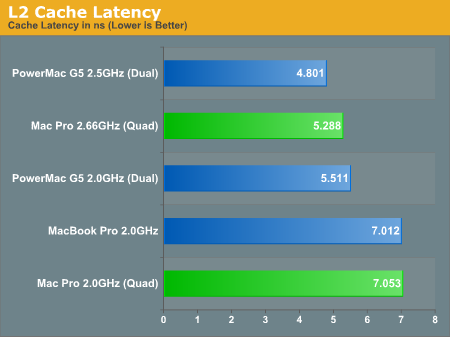
The G5 had a very quick 12-cycle L2 cache, which gives it a slight performance advantage compared to the 14-cycle L2 of the Xeons in the Mac Pro. Access latency is only one part of the puzzle however, as the G5s benchmarked here only had a 512KB L2 cache (the G5 later got an upgrade to a 1MB cache) while the Xeons in the Mac Pro have a 4MB L2 cache per chip. The G5 had a slightly faster L2, but you can reach higher clocks with the Xeon thus minimizing the effective latency and you can fit more data into the larger L2.
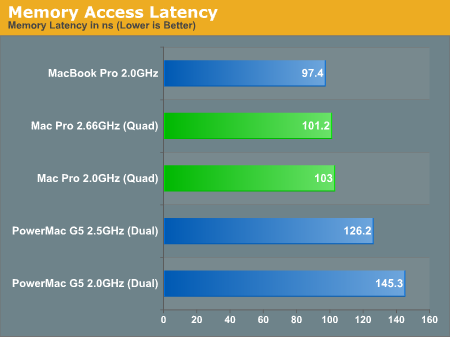
And here we see the real killer with FB-DIMMs; although the Mac Pro boasts lower latency memory accesses than the PowerMac G5, it actually takes longer to access main memory than the Core Duo processor in the MacBook Pro. This is much worse than it sounds once you take into account the fact that the MacBook Pro features a 667MHz FSB compared to the 1333MHz FSB (per chip) used in the Mac Pro.
We can further put things in perspective by looking at memory latency under Windows XP, compared to Intel's Core 2 processor. Remember that the Core 2 is identical to the Xeons in the Mac Pro, the difference being that the chipset uses regular DDR2 memory instead of DDR2-667 FB-DIMMs. Note that for our Core 2 system in the comparison below we ran the memory at DDR2-667 at 5-5-5-15 timings as well as DDR2-800 at 4-4-4-12 to provide apples-to-apples as well as apples-to-fastest comparisons.
| CPU | Everest |
CPU-Z 1.35 (8192KB, 256-byte stride) | Everest READ | Everest WRITE |
| Apple Mac Pro 2.66GHz (DDR2-667 FB-DIMM Quad Channel) | 100 ns | 87.4 ns | 4292 MB/s | 3759 MB/s |
| Apple Mac Pro 2.66GHz (DDR2-667 FB-DIMM Dual Channel) | 105.8 ns | 92.3 ns | 4141 MB/s | 3096 MB/s |
| Intel Core 2 Duo E6700 2.66GHz (DDR2-800 4-4-4-12 Dual Channel) | 59.9 ns | 52.8 ns | 7413 MB/s | 4859 MB/s |
| Intel Core 2 Duo E6700 2.66GHz (DDR2-667 5-5-5-15 Dual Channel) | 68.9 ns | 59 ns | 6782 MB/s | 4858 MB/s |
It's not Apple's fault, but FB-DIMMs absolutely kill memory latency; even running in quad channel mode, the FB-DIMM equipped Mac Pro takes 45% more time to access memory than our DDR2 equipped test bed at the same memory frequency. Things don't get any prettier when we look at memory bandwidth either.
Remember the overhead we were worried about with the serialization of parallel memory requests? With four FBD channels, the best we're able to see out of the Mac Pro is 4.292GB/s, compared to the 6.782GB/s of bandwidth our dual channel Core 2 testbed is able to provide. The efficiency table below says it all:
| CPU | Peak Theoretical Bandwidth |
Everest READ | Efficiency |
| Apple Mac Pro 2.66GHz (DDR2-667 FB-DIMM Quad Channel) | 21.3GB/s | 4.292GB/s | 20% |
| Apple Mac Pro 2.66GHz (DDR2-667 FB-DIMM Dual Channel) | 10.67GB/s | 4.141GB/s | 38.8% |
| Intel Core 2 Duo E6700 2.66GHz (DDR2-800 4-4-4-12 Dual Channel) | 12.8GB/s | 7.413GB/s | 57.9% |
| Intel Core 2 Duo E6700 2.66GHz (DDR2-667 5-5-5-15 Dual Channel) | 10.67GB/s | 6.782GB/s | 63.6% |
FB-DIMMs are simply not good for memory performance; the added capacity allowed by having 8 FB-DIMM slots on the Mac Pro had better be worth it, because if Apple were to release a Core 2 based Mac chances are that it could give the Mac Pro a run for its money in a number of memory sensitive tasks.


 Facebook
 Twitter
 RSS
RSS


96 Comments
View All Comments
retoucherman - Thursday, January 24, 2008 - link
Let me tell you! I just got a the two 2.8ghz Quad core Macpro and this baby is like driving greased lightning. Plus it is a lot quiter than the quad g5 that I had (and basically blew up becuase it couldn't take my working with it.)These second generation MacPros are a great investment (just make sure you get the 3 year Apple Care warranty - Just in case)
toonerh - Thursday, September 7, 2006 - link
Terrabit has a http://www.macprojournal.com/xp.html">site detailing how to "slipstream" Intel drivers for the Mac Pro's SATA hard drive controller and speed it up from under 4MB/s to 60 MB/s!I posted a bunch of screen shots to help those not familiar with Windows "slipstreaming" at http://st118.startlogic.com/~macproxp/index.html">my site.
Help get the word out!
nickgwyn - Saturday, August 26, 2006 - link
Anand, where is the final installment?!?I am trying to decide if I should buy this computer, and am trying to be patient in waiting for your review, but c'mon... I have to decide soon.
P.S. I enjoyed the other parts for their very in depth look at this computer.
Thanks
JAS - Sunday, August 27, 2006 - link
Yes, Anand has done a first-rate review of the Mac Pro. I think he's waiting for Apple to release a new beta of Bootcamp before finishing the next installment that will cover running Microsoft Windows on this machine.But if you're anxious, based on everything that has already been said by Anand and on many other sites, I don't think you would go wrong with ordering your Mac Pro now. Apple is aware of that SATA issue (under MS Windows. It will likely be addressed by the next Bootcamp release. Parallels is another option in the meantime. (When OS X 10.5 is released, we may not even need Bootcamp or Parallels as separate installs.)
As for me, I'll order the Mac Pro from Amazon.com because of their $150 rebate.
nickgwyn - Monday, August 28, 2006 - link
I am going to lease it from apple, it's a really good deal, if you have a business.maharajah - Thursday, August 24, 2006 - link
Anand, do you have any specs on the MacPro intake and output fans? Any model numbers, current or power ratings? Is it a 3 or 4 wire connector, or is there a custom connector on the fan housing? Can the 120mm (I assume it's 120mm) fans be replaced easily? The reason I am asking is that while the OEM fans are quiet at idle (based on the reviews), I have fans in another PC that are almost silent (<20dB from 1 foot away) at idle and load. I was thinking of replacing the MacPro's fans with these once I get the machine. Thanks.spike spiegal - Tuesday, August 22, 2006 - link
>G5s kept up well with Intel and AMD, and were often faster - sometimes much faster - but weren't going anywhere in the foreseeable future<IBM uses a similiar architecture as the G5 in the multi million dollar iSeries, and Microsoft uses a G5 clone in their Xbox 360, so the G5 architecture was hardly dead. If anything, I've heard IBM refused to lower prices on their processors to suite Apple because Apple represented so little profit.Your reply dictates the myopic view of Apple users that the G5 processors was exclusive to Apple, and IBM actually cared when you jumped to Intel.
Also, the G5 architecture has been getting it's butt kicked by AMD 64 for quite awhile, while only Altivec optimized apps on G5 really pull away. Gee, you lost Altivec on the Intel platforms, and you're froced to use Rosetta, but you're still raving about the Intel platforms. Doesn't say much about the G5 by your own admission.
>I don't know whether you're an AMD or Intel fanboi<
Neither. I use the best tool for the job, not the specific hardware a single vendor tells me to use or allows me to use like Apple does. I've migrated Windows servers from dual P3 Tualatins to dual Xeons, and then to Opterons. I'll likely switch to Woodcrest while getting the price from a vendor of my choosing, not who makes my operating system.
>A computer is just a tool to get things done
Then why are your Apple buddies raving about crap like how 'pretty' the Mac Pro is, and the layout of rear ports? You honestly to god think anybody with a legitimate IT job cares about that? Computers belong under the desk or in a server rack, not displayed on a desk like over proced stereo equipment.
>Hmm, have you heard about the best tool for the job?<
I've used dual processor G5s, and respect the way Apple has polished multimedia workflows on OSX with better productivity than Windows. Other than that, I could care less because because the world doesn't revolve around Photoshop, page layouts, and video editing.
>I would immediately insist on using XServes just because they're from Apple.<
Explains why you don't make buying decisions for your company. I've seen benchmarks of XServes getting humiliated by NT4 and Win2K in SQL benchmarks, but if I were rendering crystal balls in a server farm it would be my first choice {smirk}. Also, if the G5 based XServe is so great, why is Apple themselves procaliming the Intel based Mac Pro as significantly faster than the G5? Oops...guess you should visit Apple.com more often, are are you smarter than the server engineers in your Company because you know how to use OSX?
>Cool, e-Machines are going to be producing 8-CPU Xeon-powered workstations for $1250?<
A single, 3ghz Core 2 Duo will beat a 2.66ghz dual processor Woodcrest in about any application you hand it other than those very few that can utilize four cores. It won't take E-machine an HP long to start producing sub $1,000 workstations with the faster Core 2 Duo processors in them, and those systems will be faster than the 2.66ghz Mac Pro. Sorry for that reality check, but you are now in the Intel PC industry and have to learn to deal with it. Apple won't be able to make up benchmarks showing the superiority of their platforms because unlike the G4 and G5, the same architecture will be running Windows and Linux.
>Or maybe Apple might upgrade their offerings ... they've been known to do that occasionally<
As I said above, a 3ghz Core 2 Duo will spank a dual processor 2.66ghz Woodcrest for about 90% of the tasks you can do on a desktop. Apple could make such a system for $1250 in their iMac line 6 months down the road, but you honestly think Apple will do this and humilihate their flagship Woodcrest owners? They haven't in the past, so the ones getting screwed in the long run are Apple owners and not those of us who can pick and choose our hardware. You can then explain the logic that one to your kids when they are competing in the job market with $80,000 in college loans, but how they should only buy one product from one vendor.
plinden - Tuesday, August 29, 2006 - link
Wow, what a prick you are. Look back at my post to see what this asshole is replying to. Here's exactly what I said, full quote (I've added bold to "doesn't"):
Massaging other people's posts just makes your own arguments even weaker.
JAS - Tuesday, August 22, 2006 - link
Gosh, Spike ... lots of rage there. Why such a fierce assault on a computer that wears a happy face? ;<)I don't doubt that a 3gHz Core 2 Duo six months from now will outperform today's Mac Pro, but in the computer world there is always something "around the corner" that will be better/faster/less expensive. Most of us buy computers to suit today's needs, not next year's. The new Mac Pro is a great performer and a good value, regardless of whether you use it for Microsoft Windows or OS X.
As for Apple's servers, even their outgoing G5-based XServe has sold well to big customers. Credit card processor XTech, for instance, uses a gazillion of them. NASA has an enormous XServe installation, too.
http://www.apple.com/xserve">http://www.apple.com/xserve
spike spiegal - Tuesday, August 22, 2006 - link
Before I accuse you guys of thinking like Tom's Hardware, why don't you do us a favor and compare the Mac Pro to a single processor Core 2 Duo at the same clock? Then compare the $2500 Mac Pro to a Single Core 2 Duo running at 3ghz, and see what's faster.Gee, that 2.66ghz Core Duo system would be a LOT cheaper cheaper to build and likely perform virtually identically to the quad core Woodcrest, except for like maybe two apps that have some concept of multi-threading. The 3ghz dual core system would beat the Quad core Woodcrest at 2.66 in all but maybe one real world benchmark.
When E-machine and HP are selling $799 machines 6months to a year from now that spank the Mac Pro, what say you?