



ASUS Maximus Formula SE: X38 and DDR2 Unite!
by Rajinder Gill on November 9, 2007 7:00 AM EST- Posted in
- Motherboards
Overclocking with the ASUS Maximus Formula SE
For the vast majority of PC users, the announcement of a new CPU or chipset release generates a fair amount of interest, pegged with a realistic and thoughtful reaction towards the potential benefits (if any) over present hardware. Intel has forged ahead at such a pace this last year that it seems owning the performance crown for the foreseeable future is not even enough at this point. Releases of information from AMD about their future CPU and chipset plans have quickly been answered by Intel (with actual product releases in most cases) to ensure their continued market dominance in the enthusiast sector for the time being.
With this rapid release schedule comes improved fabrication methods that have brought many benefits: better speed scaling, lower transistor leakage, lower overall power consumption, and reduced production cost. These new CPU and chipset releases have also been coupled with competitive price cuts based on the competitive landscape that users have enjoyed the past 18 months. We have seen these improvements and strategies delivered with precision by Intel into the market place over the last year and a half while AMD has stumbled. If that's not enough, the upcoming release of the Penryn processor family features a CPU die shrink from the current 65nm process to 45nm along with additional cache sizes and several core improvements such as SSE4 support. This seems more than enough to guarantee an overall performance advantage over AMD for some time to come in the enthusiast sector.
The question from those steeped in conservatism is whether or not this industry will ever fully utilize the potential of current hardware before moving ahead to something new. From a corporate perspective, posing this question can be construed as completely naïve. Indeed, there's money to be had by making a series of small changes, while simultaneously holding a partially revealed trump card in current R&D, just in case there is the chance of a competitor counterstrike.
The Internet has become such a powerful marketing tool that a strategic selection of websites for a launch can create enough interest to guarantee a successful campaign, even when economically or performance wise a change might not be beneficial for the user. At this time, much of Intel's advertising success is accrued by placement of product in the hands of overclockers, who are enlisted to fulfill the role of presenting new hardware by showing gains in various synthetic benchmarks. This is a perfectly logical corporate decision - it is easier to sell new product to a group that is passionate about even the smallest gains than it is to satisfy the somewhat discerning real world PC user.
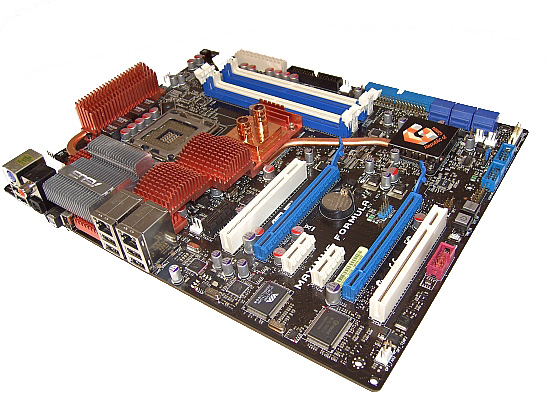
Since the launch of Core 2 Duo, we have shown that any company in support of Intel's CPU and chipset release strategy needs to have sufficient resources to co-exist with Intel's relentless marketing drive. This leads us to ASUS, who has managed to surf the Core 2 Duo wave to its full potential. They are usually among the first to release a motherboard with each Intel chipset launch, reaping the benefits of being one of the preferred launch partners for Intel chipsets. Most of the boards released by ASUS have attained substantial accolade for the most part, especially those priced in the sub $200 region. Further, there is ASUS's top of the line motherboards, the ROG (Republic Of Gamers) series. This particular product line is aimed to satisfy the needs of the upper tier gaming and overclocking enthusiasts.
Over the past year, we have seen several boards released bearing the ROG badge: the Striker Extreme, Commando, Blitz Formula, and Blitz Extreme. Most of these motherboards have been a popular choice for enthusiasts and gamers alike. Our own feelings about the ROG series is that ASUS has offered overall improvements in terms of overclocking friendly BIOS functions, component quality, features, unique on-board cooling designs, and in some cases improved compatibility - although not always. The ASUS Striker series was an especially finicky beast for non-QVL memory modules. Fortunately, the Intel chipset based boards are far friendlier in this department, a trend we hope continues with their latest products.
The latest addition to the "bells and whistles" ROG series is the ASUS Maximus Formula, based upon the Intel X38 chipset and featuring DDR2 memory support. To date, DDR2 performance using the X38 chipset has been a little underwhelming for us. Synthetic and real world benchmarks have shown little to separate X38 DDR2 scores from those using the P35 chipset. The motherboard suppliers should not be penalized for this situation as the X38 was certainly hyped to be the killer product for Intel's high-end aspirations. Our experiences with the X38 over the summer reminded us of a roller coaster ride with several highs but just as many lows as we tested each chipset revision and BIOS release. A month ago we were not excited about the X38, but with the BIOS releases maturing along with early performance results from Penryn we are ready to get back on the roller coaster.
Purchasing decisions often seem clear-cut, especially those based upon outright synthetic performance figures. Before we arrive at a conclusion today, let's look at some of the factors forcing/promoting use of the X38 chipset within selected markets (in this case the top-end enthusiast sector):
For the vast majority of PC users, the announcement of a new CPU or chipset release generates a fair amount of interest, pegged with a realistic and thoughtful reaction towards the potential benefits (if any) over present hardware. Intel has forged ahead at such a pace this last year that it seems owning the performance crown for the foreseeable future is not even enough at this point. Releases of information from AMD about their future CPU and chipset plans have quickly been answered by Intel (with actual product releases in most cases) to ensure their continued market dominance in the enthusiast sector for the time being.
With this rapid release schedule comes improved fabrication methods that have brought many benefits: better speed scaling, lower transistor leakage, lower overall power consumption, and reduced production cost. These new CPU and chipset releases have also been coupled with competitive price cuts based on the competitive landscape that users have enjoyed the past 18 months. We have seen these improvements and strategies delivered with precision by Intel into the market place over the last year and a half while AMD has stumbled. If that's not enough, the upcoming release of the Penryn processor family features a CPU die shrink from the current 65nm process to 45nm along with additional cache sizes and several core improvements such as SSE4 support. This seems more than enough to guarantee an overall performance advantage over AMD for some time to come in the enthusiast sector.
The question from those steeped in conservatism is whether or not this industry will ever fully utilize the potential of current hardware before moving ahead to something new. From a corporate perspective, posing this question can be construed as completely naïve. Indeed, there's money to be had by making a series of small changes, while simultaneously holding a partially revealed trump card in current R&D, just in case there is the chance of a competitor counterstrike.
The Internet has become such a powerful marketing tool that a strategic selection of websites for a launch can create enough interest to guarantee a successful campaign, even when economically or performance wise a change might not be beneficial for the user. At this time, much of Intel's advertising success is accrued by placement of product in the hands of overclockers, who are enlisted to fulfill the role of presenting new hardware by showing gains in various synthetic benchmarks. This is a perfectly logical corporate decision - it is easier to sell new product to a group that is passionate about even the smallest gains than it is to satisfy the somewhat discerning real world PC user.
Since the launch of Core 2 Duo, we have shown that any company in support of Intel's CPU and chipset release strategy needs to have sufficient resources to co-exist with Intel's relentless marketing drive. This leads us to ASUS, who has managed to surf the Core 2 Duo wave to its full potential. They are usually among the first to release a motherboard with each Intel chipset launch, reaping the benefits of being one of the preferred launch partners for Intel chipsets. Most of the boards released by ASUS have attained substantial accolade for the most part, especially those priced in the sub $200 region. Further, there is ASUS's top of the line motherboards, the ROG (Republic Of Gamers) series. This particular product line is aimed to satisfy the needs of the upper tier gaming and overclocking enthusiasts.
Over the past year, we have seen several boards released bearing the ROG badge: the Striker Extreme, Commando, Blitz Formula, and Blitz Extreme. Most of these motherboards have been a popular choice for enthusiasts and gamers alike. Our own feelings about the ROG series is that ASUS has offered overall improvements in terms of overclocking friendly BIOS functions, component quality, features, unique on-board cooling designs, and in some cases improved compatibility - although not always. The ASUS Striker series was an especially finicky beast for non-QVL memory modules. Fortunately, the Intel chipset based boards are far friendlier in this department, a trend we hope continues with their latest products.
The latest addition to the "bells and whistles" ROG series is the ASUS Maximus Formula, based upon the Intel X38 chipset and featuring DDR2 memory support. To date, DDR2 performance using the X38 chipset has been a little underwhelming for us. Synthetic and real world benchmarks have shown little to separate X38 DDR2 scores from those using the P35 chipset. The motherboard suppliers should not be penalized for this situation as the X38 was certainly hyped to be the killer product for Intel's high-end aspirations. Our experiences with the X38 over the summer reminded us of a roller coaster ride with several highs but just as many lows as we tested each chipset revision and BIOS release. A month ago we were not excited about the X38, but with the BIOS releases maturing along with early performance results from Penryn we are ready to get back on the roller coaster.
Purchasing decisions often seem clear-cut, especially those based upon outright synthetic performance figures. Before we arrive at a conclusion today, let's look at some of the factors forcing/promoting use of the X38 chipset within selected markets (in this case the top-end enthusiast sector):
- Intel's CPU price/performance scaling strategy: Intel uses lower default multipliers for non-Extreme CPUs, demanding higher overall FSB potential from chipsets - especially for quad-core CPUs.
- Attaining the limits of economically viable engineering practices by using a separate memory controller hub: This creates the need to push towards DDR3 rather than trying to lower overall chipset latency and increasing memory bandwidth using current DDR2 technology. Using DDR3 and associated memory timing ranges can offer superior scaling potential; testing has shown increased synthetic benchmark scores and small gains in workstation and gaming software with the right memory. The obvious selling points of X38 in DDR2 format are suggested in points 1 and 3.
- Dual x16 PCI-E 2.0 support for upcoming AMD graphics solutions (RV670 to start) to improve CrossFire performance.


 Facebook
 Twitter
 RSS
RSS


24 Comments
View All Comments
jozeaphe - Sunday, February 17, 2008 - link
Hi Guys i Just Build a new PC :Asus Maximus Formula SE .
Intel Core 2 Duo E8500 .
2 GB Ram - 800 MHz ( for the moment ) .
can any one help to overclock my PC to Max settings within the following :
1. Stock Intel CPU heatsink\fan ( come with processor ) . No water cooling on the northbridge .
2. Stock Intel CPU heatsink\fan ( come with processor ) . With water cooling on the northbridge .
3. The above 2 options but using 2 GB Ram - 1066 ( if thats make a difference ) .
And Thank u All , Jozeaphe@gmail.com .
guitronics - Wednesday, February 13, 2008 - link
I don't know if I have an 'SE',but I have the game Stalker.These Mobo's are NHRA Top Fueler's, not 18 wheeler's. They're Gaming 'Boards,not workstations,or servers.Their cause is overclocking/tweaking. So:Some legacy stuff hadda go...serial and parallel:Buy a PCI card,if you really need it.There are plenty of pci slots.No Esata? There are 6 Sata,and 1 IDE port.2 -GB Lan options.Yes,it does ECC:But why does a gamer want that?There are 1394a ports,not 800 Mhz.Or,at least that speed isn't documented.The USB mouse...it's time to get on the "dump legacy stuff" wagon.How big a deal is that?Up to 8 GB of memory,and onboard 0,1,5;and 10 Raid support.Put a Blu-Ray on the IDE,run raptors' in raid 0, still have room for > 4 < More drives....Terabyte's, anyone?A good case and you can swap 'em out...no big deal."It's a Gaming Machine"!
jay401 - Tuesday, November 13, 2007 - link
I think we've officially reached the point of option saturation, where there are literally TOO many options in the BIOS for most overclockers to ever care about. Sure, it's great for the handful that will actually make use of all of those options, but we're getting dangerously close to the point where it is TMI.RFV - Wednesday, November 21, 2007 - link
you'd love the DFI BIOS!RFV - Tuesday, November 13, 2007 - link
I have read that the Asus Maximus Formula SE is now "End Of Line" so you better hurry if you want to purchase one. Asus did the same thing with the Blitz Formula SE, so this is not suprising news, the Maximus Formula SE was always going to be a limited edition board from the get go. Also, fom the reviews I have read on this board from people who upgraded from P35 boards is that the Maximus Formula SE X38 board required more volts than the Asus P5K Deluxe board to reach the same overclock. They also reported that the X38 boards generally ran hotter than the P35 boards at the same overclock.457R4LDR34DKN07 - Monday, November 12, 2007 - link
Thanks for the in depth bios descriptions, it has helped me dramatically increase stability while using patriot pc8500 memory.Etern205 - Saturday, November 10, 2007 - link
What happened to the Maximus Extreme?Raja Gill - Sunday, November 11, 2007 - link
that's nextzoom314 - Saturday, November 10, 2007 - link
I wonder does Asus still have Locked Multipliers on Extreme cpus still like they do on the P5W DH Deluxe? Meaning any multiplier above the Default Multiplier is locked off to prevent users from overclocking, rendering an Extreme Dual/Quad cpu an Expensive Normal Dual Core or Quad Core cpu(A QX6700 becomes a Q6700 cpu). Of course one can adjust the Multiplier downwards to 6 as Asus say No one needs those upper Multipliers and Hence Asus does Not Support Extreme any cpu!!!!Raja Gill - Saturday, November 10, 2007 - link
the upwards multipliers work fine on this board...