



ATI HD 5870 Scaling Performance: X58 vs P55 Showdown
by Gary Key on September 29, 2009 12:00 PM EST- Posted in
- Motherboards
FarCry 2
We utilize the Ranch Small demo file along with the Playback Action demo to see the differences between GPU and CPU centric benchmarks. The Ranch demo is GPU centric while the Playback demo tends to be CPU centric. We run each benchmark five times and report the median score.
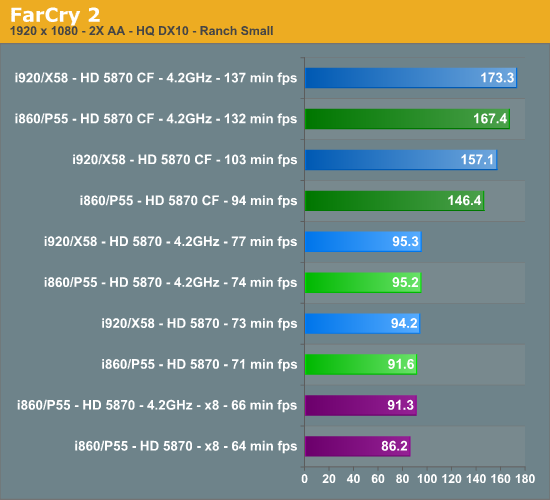
First off, FarCry 2 has always performed extremely well on the X58 chipset compared to other chipsets with the ATI video cards. This game responds very well to PCIe bandwidth, something the X58 has in droves. The stock HD 5870 single card x8 configuration is 6% slower in average frame rates and 10% slower in minimum frame rates in this particular benchmark. Even the 4.2GHz single card result is slower than either the stock P55 or X58 setups.
The stock single card HD 5870 P55 platform is 3% slower than the X58 even with a 100MHz processor advantage in turbo mode. At 4.2GHz, both platforms are about even although minimum frame rates are about 4% better on X58. However, even with this benchmark advantage, there was no difference in actual game play, especially considering minimum frame rates are above 70fps in each instance.
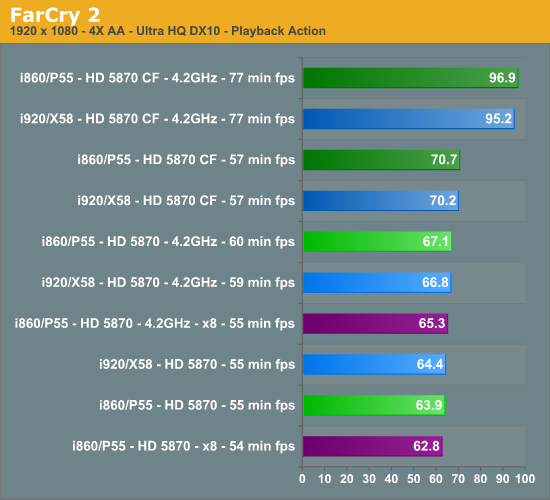
The P55 results improve slightly as we move to a more CPU centric benchmark. The stock HD 5870 single card x8 configuration is only 2% slower in average frame rates and only 1% in the overclocked results. Comparing single card results between the P55 and X58, we see a 2% difference in favor of the X58 at stock speeds while at 4.2GHz the P55 finishes slightly ahead of the X58.
The pertinent data for CrossFire scaling is in the tables below. What we are looking for is the percentage speedup going from one to two HD 5870s on X58 and P55. In theory, X58 should have improved percentages because each GPU gets 16 PCIe 2.0 lanes while Lynnfield only provides 8 PCIe 2.0 lanes per GPU.
FarCry 2 CrossFire Scaling – Average Frame Rates
| ATI HD 5870 CF Scaling | FarCry 2 – Ranch Small | FarCry 2 – Playback Action | FarCry 2 – Ranch Small 4.2GHz | FarCry 2 – Playback 4.2GHz |
| Intel Core i7 920 (X58) | 66.8% | 9% | 81.8% | 42.5% |
| Intel Core i7 860 (P55) | 59.8% | 10.6% | 75.8% | 44.4% |
Based on our single card results, there are not a lot of surprises here. At stock speeds, the X58 has a 7% scaling advantage over the P55 and 6% when overclocked in the GPU centric Ranch demo. In the Playback Action benchmark, the results favor the P55 by almost 2%.
FarCry 2 CrossFire Scaling – Minimum Frame Rates
| ATI HD 5870 CF Scaling | FarCry 2 – Ranch Small | FarCry 2 – Playback Action | FarCry 2 – Ranch Small 4.2GHz | FarCry 2 – Playback 4.2GHz |
| Intel Core i7 920 (X58) | 41.1% | 3.6% | 77.9% | 30.5% |
| Intel Core i7 860 (P55) | 32.4% | 3.6% | 78.4% | 28.3% |
Minimum frame rates and scaling heavily favor the X58 in our stock clock speed results using the Ranch demo. Although frame rates still favor the X58 in this demo when overclocked, the scaling on the P55 is slightly better. The stock results in the Playback Action demo are a dead heat with a 2% advantage to the X58 when overclocked.
When it came to actual game play, there were no differences between either platform in the game. In fact, it was very difficult to discern which system was being utilized. The key giveaway was the foot warming heat coming from our case with the X58 overclocked. Our ambient temperature in the test room rose 2.1C over the course of testing with the X58 installed compared to 0.7C with the P55.


 Facebook
 Twitter
 RSS
RSS


85 Comments
View All Comments
flade - Friday, January 15, 2010 - link
I only stick a coputer together every several years so I have to do a lot of fast-track learning in order to keep up with the new razzamataz. Don't get me wrong, I've been fiddling with them since before the first Apples fell off the trees. Probably have more pounds of computer crap in my closet than anybody.Now ignoring all the BS from these idiots trying to sell sneakers - I have to say that I ran out of steam somewhere in the middle of the 55 vs x58 and the Lynfield vs the Bloomfield family fued... Like some of you folks waste a whole lot of time bickering about who has the biggest IQ - or wingie. Yeah, well my dual-barreled, high-lift cam crankin hemi under glass will blow your doors off.
This is a good site. Why don't you friggen macho clowns restrict the chatter to the subject instead of comparing your gizmos.
maomao0000 - Sunday, October 11, 2009 - link
http://www.myyshop.com">http://www.myyshop.comQuality is our Dignity; Service is our Lift.
Myyshop.com commodity is credit guarantee, you can rest assured of purchase, myyshop will
provide service for you all, welcome to myyshop.com
Air Jordan 7 Retro Size 10 Blk/Red Raptor - $34
100% Authentic Brand New in Box DS Air Jordan 7 Retro Raptor colorway
Never Worn, only been tried on the day I bought them back in 2002
$35Firm; no trades
http://www.myyshop.com/productlist.asp?id=s14">http://www.myyshop.com/productlist.asp?id=s14 (Jordan)
http://www.myyshop.com/productlist.asp?id=s29">http://www.myyshop.com/productlist.asp?id=s29 (Nike shox)
AndyKH - Sunday, October 4, 2009 - link
I'm a bit confused about the uncore clock frequency. From what I've gathered from all the discussion about the Lynfield having an advantage from the 200 MHz higher uncore clock frequency, I've concluded that uncore clock is represented by the NB (North Bridge?) frequency in the CPU-Z screenshots. But when running at stock speeds, I can't get it to match for the bloomfield: For Lynnfield CPU-Z shows 2.4 GHz NB frequency, but for bloomfield it shows ~3.3 GHz NB frequency! However, according to one of the original articles http://www.anandtech.com/cpuchipsets/showdoc.aspx?...">http://www.anandtech.com/cpuchipsets/showdoc.aspx?... (can't get the http link button to work) about Nehalem, the uncore clock should run at 20x the BCLK ~2.66 GHz.So how does all this come together?
Is the NB frequency really the uncore clock?
And what about the QPI clock number for Lynnfield, why is that even shown - doesn't Lynnfield completely lack a QPI link, or is the QPI clock used for anything else than actual QPI interface?
A comment to Gary: I really enjoyed reading the article, but (and this might just show my ignorance because I haven't read every article about the Nehalem architecture) I would really appreciate some kind of walkthrough of the numbers shown by CPU-Z and Everest, where it is explained how the naming of different values relate to the names used in articles about CPU architecture.
Thanks in advance
duploxxx - Friday, October 2, 2009 - link
Really nice testing and effort, but the only way to make such a compare complete is to really use all possible solutions, by adding a 790fx platform you would have brought some real value to all customers and finally get rid of all the possible biased/brand favor comments most sites (and so does anandtech) get all the time.Gary Key - Friday, October 2, 2009 - link
That is coming... :)blindbox - Thursday, October 22, 2009 - link
Hearing that makes me give you a two thumbs up in real life :)We are still waiting for a better commenting system. I mean, I can't even see my past comments. Can't you integrate with the forums like how TPU did?
mapesdhs - Thursday, October 1, 2009 - link
Gary, do you know if there are plans to release a pro equivalent of
these cards, ie. FireGL or somesuch? I've spent quite a lot of time
recently helping various places go through purchases of dual quad-core
i7 XEON systems with FX5800 cards. In every case, the overall focus of
GPU support from the supplier was on Quadro FX cards, eg. SGI's new
Octane III doesn't mention ATI FireGL cards at all:
http://www.sgi.com/products/servers/octaneIII/grap...">http://www.sgi.com/products/servers/octaneIII/grap...
What has happened to AMD's professional GPU range? Have they given up?
Ian.
Gary Key - Thursday, October 1, 2009 - link
Ian,I am waiting on an answer from AMD right now. I heard they would have a new line of Professional cards based on Cypress in Q1, just wanting them to confirm it again. Email me and I can answer you once I have the answer.
:)
atmos - Wednesday, October 7, 2009 - link
Did you hear back on why the ATI folks think the results are so different from the tests with the Nvidia 260 etc cards?capeli - Wednesday, September 30, 2009 - link
The results are not surprising. Given that the 5870 performs roughly at the level of a 4870x2 it's not surprising that the scaling is more or less the same the 4800 series.I'm guessing that Lynfield will start to become a bottleneck with the 5870x2 quadfire/trifire (5870x2 + 5870) setups.
Personally I went for Bloomfield, because I had great success with my 4870x2 + 4870 setup. Had heat issues that were resolved by adding a better fan to my intake on the side panel. It's a tad noisy, but the performance is superb. So much so that I don't see myself upgrading to DX11 until mid 2010.
18 months of top notch performance is pretty good for fast moving tech like graphics cards.