



Western Digital WD1500ADFD: King Raptor
by Gary Key on February 8, 2006 1:30 AM EST- Posted in
- Storage
"It takes a long time to bring excellence to maturity."
This maxim by improvisatore and Latin writer Publilius Syrus expresses our thoughts on the third-generation Raptor from Western Digital. This latest release in the Raptor series comes almost three years after the original Raptor WD360GD was launched.The original Raptor was launched as the WD360GD in March of 2003 with an enterprise level 10,000 RPM spindle speed, SATA interface, 8-Megabyte buffer, 5.2 millisecond read seek time, and a single-platter design featuring 36 gigabytes of storage. While it shined in single-user performance, the drive did not fare well against its SCSI based competitors in the enterprise server market for which it was designed. It's already small size and complete lack of command queuing abilities delivered performance that was not on par with the SCSI based drives in the critical multi-user applications. However, due to the lack of entry level SCSI drives, a growing interest in SATA components, and a very avid computer enthusiast market, the drive was able to succeed until its replacement arrived.
The next version of the Raptor was launched as the WD740GD in December of 2003 and boasted several needed enhancements. These enhancements included the addition of another platter that increased the capacity to 74-gigabytes, 4.6 millisecond read seek time, a FDB based motor to address noise concerns, and ATA-4 tagged command queuing. While TCQ was a welcome addition and certainly improved the drive's I/O operations, it still was not a match for most SCSI drives in the enterprise market. This was primarily due to a lack of SATA controllers that fully supported TCQ and firmware as mature as the SCSI competition.
However, this drive was consistently and, in some cases, continues to be one of the fastest single-user performance drives available. The computer enthusiasts flocked to the drive due to its performance advantages, but the drive continued to have limited success in the enterprise server market. In a nod to the success of the drive in the computer enthusiast market and acceptance of its importance, Western Digital offered the drive in retail stores for a short time. Over the course of the last two years, the drive has been enhanced with minor revisions with the latest version, WD740GD-00FLC0, receiving tweaks that have improved its performance mainly in single-user applications. Although the drive's capacity is dated compared to the newer 300~500 gigabyte SATA drives, its price-to-performance factor is now attractive.
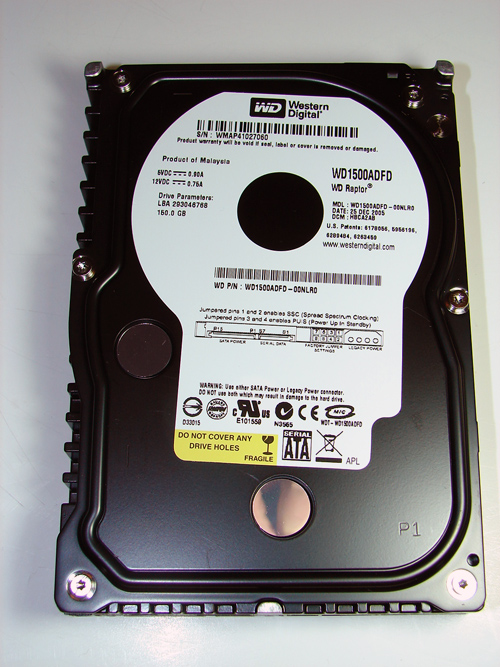
Like the recently released Caviar RE2 WD4000YR drive that is based on the latest Raptor platform, this drive supports Time Limited Error Recovery and Rotary Acceleration Forward Feed operations. TLER allows the drive to signal the RAID host adapter in the event an error recovery process has exceeded time out parameters. This prevents false drive dropouts on the host adapter when utilizing RAID level 1 or above configurations. Although TLER is disabled by default, a utility might be available in the future from Western Digital to enable TLER. RAFF is an electronics feature that senses rotational vibration in a multi-drive setup and then compensates for it by controlling the drive head location. This feature is designed to keep read and write operations consistent, thus avoiding time consuming retries by the drive that could impact performance.
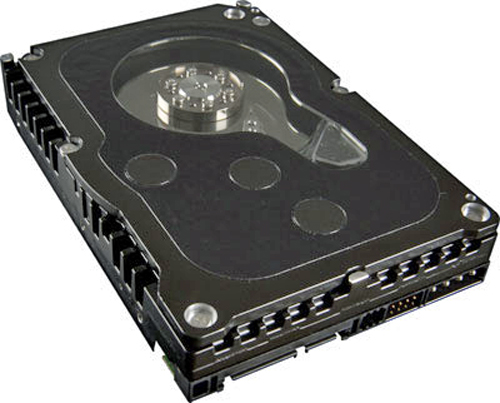
Thus, Western Digital will have two different models of basically the same drive in the market place. The WD1500ADFD will be primarily targeted as an entry-level alternative in the enterprise market with the WD1500AHFD being targeted to the computer enthusiast and gaming user.
The Raptor X model differs cosmetically from its parent by offering a transparent cover over the spindle and platter section of the drive. The cover was designed from a special grade of crystalline polycarbonate with a unique ESD-dissipative coating. The combination of this cover and the conductive frame design will protect the read/write heads from potentially damaging static discharge.
Let's see how the newest Raptor performs against other SATA based drives.


 Facebook
 Twitter
 RSS
RSS


51 Comments
View All Comments
shady28 - Sunday, April 9, 2006 - link
Kinda bogus review here. How on earth can you put a SATA drive in comparison to other SATA drives, then draw conclusions about SATA vs SCSI?? The answer is you can't, especially in regards to SATA being 'ready' for use in big fileservers. It's a cheap alternative to SCSI, not a performance alternative. Check the link below for fileserver iometer (IOPs) benchmarks of many different drives, and you'll find that the top SCSI drives demolish the top SATA drives with nearly double the IOPs ratings :
http://www.storagereview.com/comparison.html">http://www.storagereview.com/comparison.html
Kensei - Friday, February 10, 2006 - link
I've said it before but I'll say it again... Gary sets the standard for technical writing excellence. His work should be studied closely by all who aspire to do this type of work. I hope you're at least 26 or older becasue if you're writing like this at 19, 20 or 21, I think I'm going to get sick... with jealousy.Kensei
SpecOps - Friday, February 10, 2006 - link
I would have liked to see the "value Raptor" in the tests as well, so we can get a better picture of price vs. performance.Gary Key - Friday, February 10, 2006 - link
I will see if we can get a WD4000 series and update the article or at least have it for the RAID follow up. We have the new WD 500GB drive to test also.JustAnAverageGuy - Thursday, February 9, 2006 - link
Good article Gary, look forward to more in the future.One of the few editors who actually reads and replies to more than just one or two comments. :thumbsup;
- JaAG
CrystalBay - Wednesday, February 8, 2006 - link
Gary , you have a very proficient writing ability . I noticed it on your first review at AT keep up the good work...MadAd - Wednesday, February 8, 2006 - link
I just checked and prices for these in the UK is £210 - its almost the price of a scsi drive ffs (a 147gig hitachi u320 is only £50 more).
Im not quite sure what market segment these are aimed at, I just hope they dont shoot themselves in the foot being priced so close.
yacoub - Wednesday, February 8, 2006 - link
Gary - Thanks for this excellent review and for addressing the two primary complaints I had with the last harddrive review here: The old Samsung drives listed and lack of SP2405C and the tiny decibel test graph that was hard to read and draw conclusions from.This test has a great lineup of drives tested and much better graphs. Very nicely done!
Gary Key - Thursday, February 9, 2006 - link
Thank you and actually everyone for the comments. We have certainly listened to the requests and hopefully our improvements over the course of the next few articles will be satisfactory for everyone.
Although I have had some personal issues with Samung drives in the past I have to give them credit for producing a very good drive in the SP2504c. It would be my drive of choice in a HTPC or SFF setup at this time if you need a silent drive. The performance of the drive is competitive with others in its class for the most part at a very good price point. I tested the drive last night in a sound enclosure and there was only a 5 decibel difference between idle and constant read/write operations. I believe some of the additional decibel readings in the article is our equipment picking up noise from the drive cage. We will continue to refine this process for testing but the readings we reported were very consistent given the environmental conditions in the test room.
Jeff7181 - Wednesday, February 8, 2006 - link
I agree with those that say a Part 2 with RAID testing would be interesting.