



Seagate and Western Digital 1TB Drives: Improved and Green
by Dave Robinet on November 26, 2007 7:00 AM EST- Posted in
- Storage
Introduction
When one manufacturer has a breakthrough in hard drive capacity, the other manufacturers rush to make sure their product line contains at least one entry at the new capacity level. However, it can sometimes take a while for actual product to arrive after these announcements, so it can be difficult to buy the particular drive that a consumer wants. Fortunately, the distribution channels have begun to fill with 1TB drives over the last several months, and consumers are now able to buy these massive hard drives with relative ease. In our head-to-head comparison today, we pit Seagate's 1TB Barracuda 7200.11 ES.2 against Western Digital's 1TB Caviar GP, along with updated results from the Hitachi 1TB drive that kicked off the "Era of Tera".
The Combatants
After Hitachi, Seagate was the first of our competitors out of the gate with its 1TB drive announcements, listing several different incarnations of its largest-capacity drive. Seagate positions their Barracuda 7200.11 as a desktop-class drive.
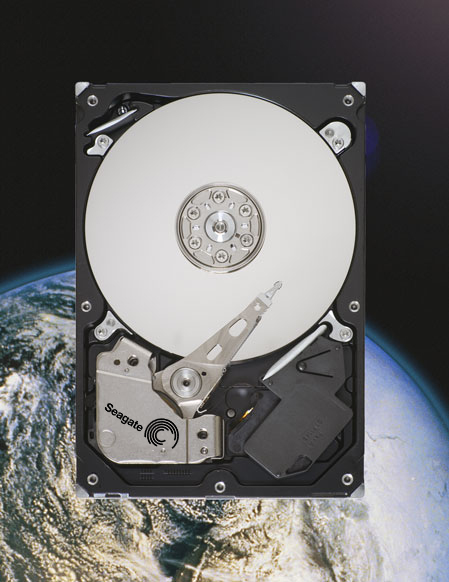
Seagate leverages its industry-leading five-year warranty and PMR recording technology in their mainstream 7200.11 desktop class drive. Anyone familiar with Seagate's drive naming conventions will recognize that this drive is the eleventh generation of their 7200RPM mainstream drives, marking over 15 years that they have been producing drives at that spindle speed. We were surprised once again at the launch of this new class of drive, as Seagate announced the 7200.10 series just over a year ago. The major enhancement in the 7200.11 product series over the 7200.10 is a simple increase in areal density. The platter size increases from 188GB on the 7200.10 series to 250GB on the 7200.11 product. This increase in density is the primary reason for the claim of this drive being "second generation PMR recording technology". The other major change is an increase from 16MB cache to 32MB cache on the 1TB drive. We will look to find out what performance benefits, if any, come with this "second generation" technology.
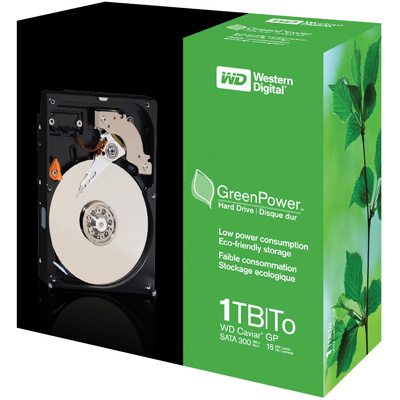
Western Digital followed Seagate's lead in introducing their 1TB Caviar GP in July of 2007, though their approach to the technology differs considerably. Where the Seagate drive focuses on reliability and trading on their established name, the Western Digital Caviar GP seeks to set itself apart with its low power consumption. This "green" approach - dubbed "environmentally responsible storage" in their product literature - attempts to portray the GP line as environmentally friendly due to a low power consumption figure. While we can all appreciate lower power requirements in our computing components, it remains an open question if users are willing to accept any performance trade-offs to get there. Our main question today is if Western Digital's focus on being "green" comes at the cost of performance, and how does the new Seagate 7200.11 compare to the 7200.10 series. Let us look at the specifications to see the numbers behind the headlines.


 Facebook
 Twitter
 RSS
RSS


31 Comments
View All Comments
Luminair - Tuesday, November 27, 2007 - link
"Operating System Stated Capacity"Lets be clear so maybe you can be clear in the next article.
The IEC, IEEE, CPIM, and NIST define Giga (G) as 1,000,000,000 or one billion.
The same standards organizations define Gibi (Gi) as 1,073,741,824.
As such, by standard definitions, these hard drives are in fact 1000GB, or 1000 gigabytes.
Your "Operating System Stated Capacity" really means "Windows Explorer Capacity". Other operating systems don't get it wrong like Windows does. So if you report this wrong information at all, you should make the truth known -- that Windows is well known to WRONGLY report GiB as GB (and MiB for MB and so on).
Those drives have 1000 gigabytes of space. Windows Explorer and solid state memory companies report the space incorrectly.
Luminair - Friday, November 30, 2007 - link
These guys get it right :) http://www.pcgameshardware.de/?menu=browser&ar...">http://www.pcgameshardware.de/?menu=bro...&ima...valherumk2 - Tuesday, November 27, 2007 - link
Looks like another review of the 7200.11 drive where it appears the reviewer didn't remove the jumper limiting it to SATA 1. Interface bandwidth burst rate is over 200MB/s on my 7200.11 with the jumper removed.Zap - Thursday, November 29, 2007 - link
That's also the first thing that came to my mine... "dude forgot to remove the jumper."Zap - Thursday, November 29, 2007 - link
That's also the first thing that came to my mine... "dude forgot to remove the jumper."100proof - Monday, November 26, 2007 - link
Dave, is there a reason that Samsung's 1TB drivewas not included in this review? The drive is
difficult to obtain in the US but is available in
other countries at this point in time. Tomshardware
has already posted a review, and there is also
discussion taking place on storagereview.com
Tomshardware Review of Samsung F1 1TB
http://www.tomshardware.com/2007/11/21/samsung_ove...">http://www.tomshardware.com/2007/11/21/samsung_ove...
Storagereview discussion of F1 Series
http://forums.storagereview.net/index.php?showtopi...">http://forums.storagereview.net/index.php?showtopi...
Dave Robinet - Tuesday, November 27, 2007 - link
It's a matter of availability, not of lack of interest. We do like the latest Samsung offerings - they simply didn't have a drive shipped to us in the lab in time for the article.If they get us a 1TB drive for us to have a look at, then we'll gladly put it in a future article.
Thanks for reading!
quanta - Wednesday, November 28, 2007 - link
In the meantime, Tom's hardware did the Samsung Spinpoint F1 review[1], which showed it has great non-server performance. In fact, it outruns WD Raptor WD150ADFD in some tests. Power consumption is between 'cuda 7200.11 and Caviar GP.[1] http://www.tomshardware.com/2007/11/21/samsung_ove...">http://www.tomshardware.com/2007/11/21/samsung_ove...
piasabird - Monday, November 26, 2007 - link
You get a lower overall price per Gig by using two 500 gb drives.Googer - Monday, November 26, 2007 - link
With a pair of 500GB hard drives, you do not get it in a single volume, power consumption increases, RAID 0 decreases reliability and increases error possibilities.The fact that it takes two drive bays is a sore thumb to those who build small form factor multi-media systems with only one drive bay that will also funtion as a Digtal Video Recorder.
I should also add, this "GREEN" drive is ideal for a TiVO upgrade due to it's large size, quiet operation, low heat, and noise output.