



Exclusive: SLI Head-to-Head: Monarch Micro-ATX vs. Shuttle SFF
by Jarred Walton on March 6, 2006 8:56 AM EST- Posted in
- Systems
Introduction
There are as many different philosophies on what goes into the creation of an ideal computer as there are individuals in the world. They range from "whatever my friend tells me" to "the best performance money can buy." While the merits of the individual philosophies can be debated ad nauseum, that is largely a fruitless endeavor. People like what they like, and that's perfectly okay as far as we're concerned. What we're here to look at today are a couple of systems that satisfy the desire for maximum gaming performance in the smallest space possible. Yes, we're talking about Small Form Factor systems, though this time, with a slight twist.
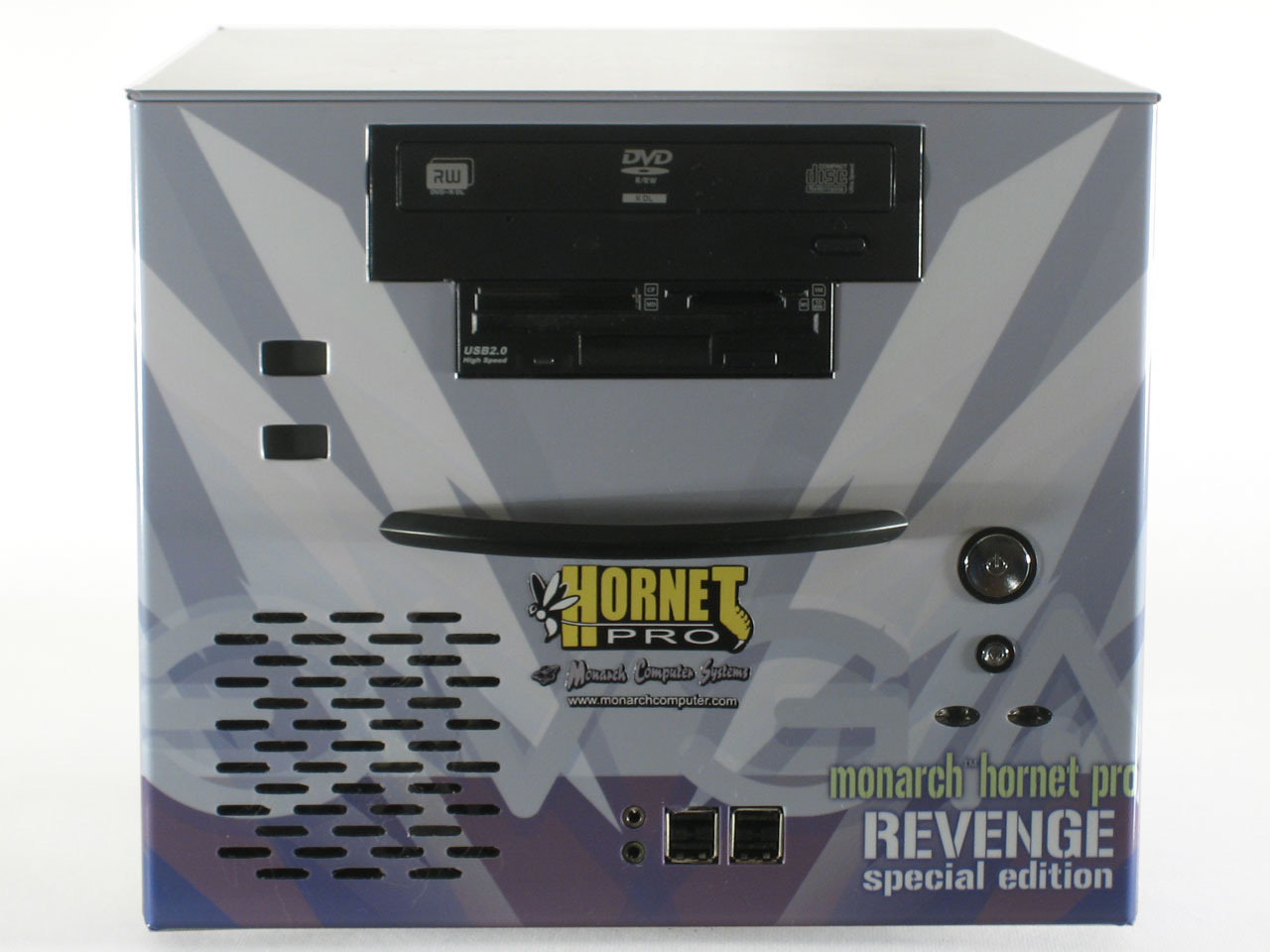
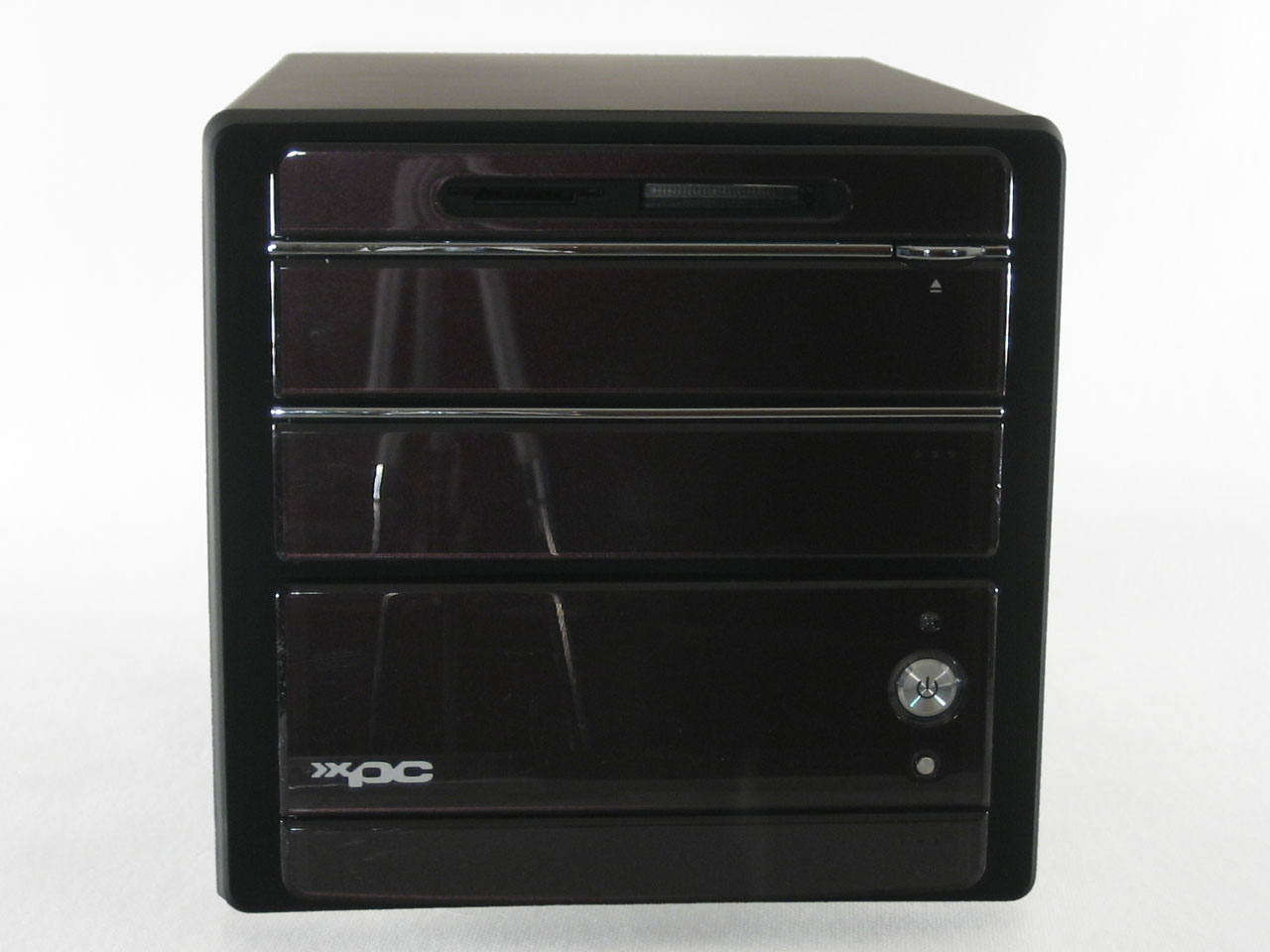
The twist comes in the inclusion of a system that isn't a Small Form Factor design in the strictest sense of the word. We have the latest Shuttle SN26P SLI-capable unit, and we also have Monarch Computers' latest foray into the small computer world, the Hornet Pro SLI Revenge. Both are quite a bit smaller than your typical mid-tower ATX case, but where the Shuttle is targeted primarily at reaching the smallest size possible while still offering competitive performance, Monarch goes with a micro-ATX (uATX) form factor. In exchange for size, you get some other options, which we'll discuss more during the course of this review.
There are quite a few items to discuss with both systems, but we've already covered much of the information on the Shuttle in our look at the SN25P. If you're unfamiliar with the Shuttle P chassis, you will find it helpful to read that review first, as we will mostly focus on what changes are present in the SN26P rather than repeating all of the previous material. We'll start by looking at the Monarch Hornet design and then we'll compare that to the Shuttle SN26P and look at the different philosophies. We'll also have our typical battery of benchmarks to show whether or not these diminutive cases really can hang with their bigger brother ATX cases, particularly when SLI is added to the equation - we've shown in the past that SFFs don't have to give up anything in the way of performance, but until recently, dual GPUs have been a feature reserved for the highest-end ATX systems.
There are as many different philosophies on what goes into the creation of an ideal computer as there are individuals in the world. They range from "whatever my friend tells me" to "the best performance money can buy." While the merits of the individual philosophies can be debated ad nauseum, that is largely a fruitless endeavor. People like what they like, and that's perfectly okay as far as we're concerned. What we're here to look at today are a couple of systems that satisfy the desire for maximum gaming performance in the smallest space possible. Yes, we're talking about Small Form Factor systems, though this time, with a slight twist.
 |
 |
| Click on images to enlarge. | |
The twist comes in the inclusion of a system that isn't a Small Form Factor design in the strictest sense of the word. We have the latest Shuttle SN26P SLI-capable unit, and we also have Monarch Computers' latest foray into the small computer world, the Hornet Pro SLI Revenge. Both are quite a bit smaller than your typical mid-tower ATX case, but where the Shuttle is targeted primarily at reaching the smallest size possible while still offering competitive performance, Monarch goes with a micro-ATX (uATX) form factor. In exchange for size, you get some other options, which we'll discuss more during the course of this review.
There are quite a few items to discuss with both systems, but we've already covered much of the information on the Shuttle in our look at the SN25P. If you're unfamiliar with the Shuttle P chassis, you will find it helpful to read that review first, as we will mostly focus on what changes are present in the SN26P rather than repeating all of the previous material. We'll start by looking at the Monarch Hornet design and then we'll compare that to the Shuttle SN26P and look at the different philosophies. We'll also have our typical battery of benchmarks to show whether or not these diminutive cases really can hang with their bigger brother ATX cases, particularly when SLI is added to the equation - we've shown in the past that SFFs don't have to give up anything in the way of performance, but until recently, dual GPUs have been a feature reserved for the highest-end ATX systems.


 Facebook
 Twitter
 RSS
RSS


13 Comments
View All Comments
dworley - Monday, March 6, 2006 - link
I was pretty dissapointed with this review, the SN26P did not get a fair shot since the reviewer obviously did not do his homework!A simple google search and they would have found NUMEROUS posts on SFFTECH at the least, regarding discussion of clearance issues with the EVGA ACS KO boards not fitting in the SN26P due to the back ram plate. I know I had responded to several Q's on this myself.
Here's a pic of my SN26P with the EVGA KO cooler on the outside card only:http://img.photobucket.com/albums/v246/dworley/DSC...">SN26P SLI Pciture
My SN26P works GREAT with the ACS cooler on my outside card only - the annandtech reviewer could have simply changed out the back ram plate on the inside card with a stock one to complete a fair comparitive review but they are too lazy to do a little research apparently before choosing the right Video cards.!
Anyway here's what the SN26P is capable of in the hands of a skilled SFF enthusiast:
SN26P FX-60 with BFG 7800GTX SLI - http://img.photobucket.com/albums/v246/dworley/3dm...">3DMark05 score - 13811 (Could not publish this project due to "unknown CPU")
SN26P FX-55 with BFG 7800GTX SLI - http://service.futuremark.com/compare?3dm05=134313...">3DMark05 compare - 12274
SN26P FX-55 with EVGA 7800GTX 512 - http://service.futuremark.com/compare?3dm05=169573...">3DMark05 compare - 10172
SN26P FX-55 with BFG 6800GT SLI - http://service.futuremark.com/compare?3dm05=146102...">3DMark05 compare - 10161
The SN26P has definitely handled everything I have thrown at it - and it's practically silent at idle when using my speedfan config. I completed FEAR, QUAKE4 and COD2 on it with the FX-55 and dual BFG 7800GTX's and it never had any stability issues - even after many hours of continous gaming. Thta's pretty impressive for a 350W PSU and that small of an SFF running SLI - I have to hand it to Shuttle as their ICE system is very effective with high end CPU's and it exhausts all the hot air out of the system.
My only real gripe with the SN26P and why I am not using it currently is the lack of a PCI slot to run my X-fi for BF2 so that I can have positional 5.1 audio. I wish Shuttle could have at least offered a rear PCMCIA slot on the SN26P to use that Audigy2 ZS notebook card at least or better yet - integrated Audigy2 or X-fi!
I know that as soon as I sell it - Creative will announce a USB X-fi!
JarredWalton - Monday, March 6, 2006 - link
{Author's note: The above post is a repost from another message forum, and was not actually written by dworley as far as I'm aware. You can http://www.hardforum.com/showthread.php?t=1027547">view the original source if you'd like.)There are infinite numbers of ways to try and get hardware to work in a system. Case/card/hardware modding is a niche market, and as such I assume that anyone that wants to go that route already knows the proper way to go about it. A few things to point out:
1) The stock EVGA KO will not allow you to install two cards in the SN26P. This is a fact.
2) The ACS cooler on the EVGA KO cards serves a purpose, as our reviews of the 7800 GTX cards showed that it managed to clock and overclock higher. Removing the back RAM heatsinks seems to be going the wrong way if you're after performance.
3) Of course, you might be able to get around that by adding a couple of fans on the top of the graphics cards to aid in keeping them cool, just like you've shown in your SN26P image. Unfortunately, now the SN26P isn't as quiet as it was before. Again, that's going the wrong way as far as I'm concerned.
4) I didn't include benchmarks with two regular 7800 GTX cards because I don't have two such cards available. I do have a single 7800 GTX that comes factory overclocked to 450/1250, but the funny thing is that the card will often crash even in a large ATX case with plenty of airflow. Not all 7800 GTX cards will run faster than 430/1200 without taking special measures (i.e. better HSFs or even water cooling).
5) The apples-to-apples results are to show how the systems perform with equivalent hardware. What you do outside of the tested solutions is your choice, but with identical setups the SN26P appears to be a bit faster. I did the tests with 11 different configurations in order to be as fair as possible; if I had just run one configuration of each system through some benchmarks, *that* would have been unfair and would rightly deserve accusations of me not doing my homework. (The EVGA board needs some BIOS tuning, I would say.)
Basically, sure you can try and mod a 7800 GTX KO to fit in the Shuttle, but what's the point of discussing all the various mods you can make? You could also try and mod some X1900 XT+CrossFire cards as well and then maybe hack the drivers to run CrossFire in the SN26P. Does that make it a worthwhile recommendation to the various enthusiasts/gamers of the world? Anyone interested in special hardware tweaks is on their own, of course, as our goal is to review the systems as people will buy them.
Looking to the future, we've got dual-slot and single-slot 7900 cards probably coming out within the next two months. (I don't know for sure since I'm not the GPU editor at AnandTech.) The dual-slot cards are almost guaranteed to have higher clock speeds, if that's what you're after - probably 7800 GTX 512MB performance only available in quantity and at a lower price, and possibly even faster by a decent amount.
If anything in this article made you think that I *don't* like the SN26P, then I should probably fix it. BOTH systems are good, and both deserve consideration. I like the looks of the Shuttle more, I like its lower noise levels more, but in the end a Hornet Pro SLI does offer the potential for more performance.
Take care,
Jarred Walton
SFF and Guide Editor
AnandTech.com
dworley - Monday, March 6, 2006 - link
Actually this is "me" as my login is the same on both forumsMy point is that you could have easily obtained two high end 7800GTX cards that would have fit in the SN26P and Hornett to provide a more thorough review of high end video SLI performance between the two systems.
Out of all of the 7800GTX choices you happened to pick the one that does not fit properly with SLI in the SN26P? The only other 7800GTX card that has a single slot cooler that is known not to fit in the SN26P is the most recent version of the BFG 7800GTX that has a new style copper cooler. I agree that the EVGA cooler servers a purpose, especially for the outside SLI card in the SN26P which has restricted airflow and cooling (which is why I modded my outside BFG card with the EVGA ACS1+ coooler)
YES, I did "MOD" my SN26P by re-locating the two rear Shutlle 60mm case fans above my video cards to help cool my $1200 inverstment in the picture I posted. But it is really not necessary and I have since gone back to stock configuration with no issues.
I use Speedfan which allows me to control each individual fan speed in the SN26P and it is practically silent at idle. That is true even with the fan mod since I was using the same fans as stock with the addition of two 60MM silenX fans for the rear case which are 16dba.
JarredWalton - Monday, March 6, 2006 - link
Oops... sorry dworley! I got an email from [LYL]Homer regarding your message (about 15 minutes before your post here) and I ended up confusing you two. I was thinking he reposted your message here for response. My apologies for the confusion - but the linked forum does have the entire message in context so everyone can see my error. (I'd edit my above post to correct this, but alas that function is still missing.)Anyway, let me clarify: I got the SN26P from Shuttle for testing, but no high-end video cards. The Revenge was sent from Monarch with the configuration tested. I did ask around to try and get a second 7800 GTX card to go with the one I already have, but given the choice of buying one, waiting perhaps a couple weeks to see if I could get one sent to me, or just going with what I had available, I took the latter route. I didn't choose the EVGA KO just to put the SN26P at a disadvantage; it was merely what I had on hand.
Yes, the SN26P will work with up to two 7800 GTX cards right now. My own experience with a 7800 GTX that was slightly overclocked is that they can become a bit finicky. Putting two of them into such close quarters definitely makes me nervous - not nervous as in I think I'll fry the cards, but nervous in that I worry about stability during longer gaming sessions.
Ideally, I would want to test both systems along with a third ATX SLI system in several configurations. At the ultra-ultra-high-end would be two 7800 GTX 512MB cards, but given the price and availability I didn't even worry about it. The EVGA KO is a step down but they're widely available at a reasonable price. Unfortunately, they don't fit in the Shuttle without modification, and as said that isn't an area I wanted to get into. I would have liked to throw in two 7800 GTX cards as well as two 7800 GT cards, but given the amount of time already being taken, that becomes impractical.
I like to think that with the tests run, it becomes easy enough to look at other articles and benchmarks to determine how other configurations would work. Pretty much if you can fit the parts into the SN26P, it will run. Is it worth the cost compared to an ATX system? If you want a smaller case, probably. Most people will still be fine with an SN25P and a single GPU, though.
Given the choice between (SN26P + two 7800 GTX = $1460) and (Biostar 330P + one 7800 GTX KO + X-Fi = $976) or even (SN25P + X1900 XT = $881) I would personally go with the latter options in a SFF setup. Does that mean the SN26P is bad? Nope. It's expensive, when you throw in the cost of SLI, but it's still a very cool looking system. I still say that if I were looking for an SLI system I'd want the option to run two large GPUs and/or a sound card.
Take care, and sorry again for the confusion. :)
Jarred Walton
SFF and Guide Editor
AnandTech.com
dworley - Tuesday, March 7, 2006 - link
Well since Monarch supplied the Video cards and Shuttle did not then they deserve to be disadvantaged - the $20 question is did Monarch plan this on purpose to send those specific cards for your review knowing you could not use them in the Shuttle? ;)Thanks for clearing up the issues you faced for testing, I guess I did not realize that you would have such limited resources or control over hardware available to complete the reviews - I got this picture in my head of some big fancy lab with endless rows of test benches and parts of every variety ;) LOL
JarredWalton - Tuesday, March 7, 2006 - link
Don't I wish! (Though I'm working on it.... heheh.) I've got quite a few CPUs, GPUs, RAM, SFFs... but when it comes to high-end GPUs, I've got one 7800 GTX, and quite a few low to mid/high-end cards. I need to live closer to Derek (our graphics editor). :DPeteRoy - Monday, March 6, 2006 - link
The 1.2 patch for BF2 actually does increase FPS for Nvidia video cards.CZroe - Monday, March 6, 2006 - link
Why is the author concerned with motherboard upgradability and SLI vs High end single card? These systems are basically for people who have already made up their mind about SLI vs. single GPU and SFF vs. mini-PC. Sure, you can upgrade the Hornet mobo where you can't upgrade the Shuttle but that's because thte Shuttle is a true SFF. Also, you can't just commission eVGA yourself to make another mobo to your specs so I can only see "upgrading" to more modern but less capable uATX mobos. There's no reason to go on about "God forbid" if you want to upgrade a Shuttle SFF. Anyone buying one knows that it's sold as a barebone kit for that very reason. So who is the author making the point to? It's all just padding for the article.JarredWalton - Monday, March 6, 2006 - link
Motherboards fail, it's a fact of life. If the motherboard in a Shuttle fails, that's going to be a real pain to fix yourself. It's a bit easier to swap out the motherboard in the uATX Hornet Pro. It's not that I'm super concerned, as I mention elsewhere in the article that I would generally sell off/give away a computer and build a new one rather than trying to upgrade the motherboard. It was one comment meant to illustrate that uATX does have some potential advantages over a true SFF.As for SLI vs. Single GPU? Of course that's something to discuss in such an article. Why should you go out and buy two high-end GPUs if you don't need to? My job as I view it is to help people make up their minds about what they need/want - or don't as the case may be. Given the choice today between spending $800 to $950 on two 7800 GTX cards vs. $460-$600 on an X1900 XT/XTX, I would go with the latter.
AGAC - Monday, March 6, 2006 - link
What about HDCP support? It is an important feature and I think the press in general is strangely overlooking it. I want my next system to be able to playback current and next HD content. I don´t have a clue if the current HDCP spec is still valid and if it is, why the major vendors (gpu and display) don´t support it. Vista is just around the corner and so is the next gen HD formats (HDDVD, Bluray or whatever third alternative comes next). What kind of hardware is not going to be obsolete overnight is of the utmost importance before taking the plunge when assembling my next system.