



ATI Radeon X1950 Pro: CrossFire Done Right
by Derek Wilson on October 17, 2006 6:22 AM EST- Posted in
- GPUs
Battlefield 2 Performance
This benchmark is performed using DICE's built in demo playback functionality
with a few added extras built in house. When using the built in demo playback
features of BF2, frames rendered during the loading screen are counted in the
benchmark. In order to get a real idea of performance, we use the
instantaneous frametime and frames per second data generated from a benchmark
run. We discard the data collected during the loading screen and calculate a
result that represents the actual gameplay that was benchmarked. While DICE
maintains that results over 100fps aren't reliable, our methods have allowed
us to get useful data from high performing systems.
During the benchmark, the camera switches between players and vehicles in
order to capture the most action possible. There is a lot of smoke and
explosions, so this is a very GPU intensive Battlefield 2 benchmark. The game
itself is best experienced with average in-game framerates of 35 and up.
We ran Battlefield 2 using the highest quality graphics settings we could.
Shadows, lighting, and especially view distance are very important in order to
best play the game. In our opinion view distance should never be set to less
than the max, but other settings can be decreased slightly if a little more
performance or a higher resolution is required.
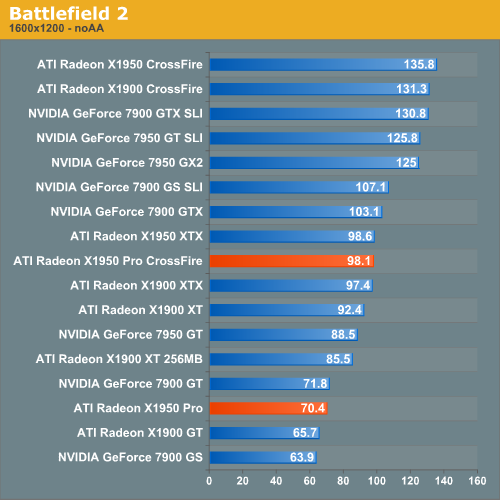
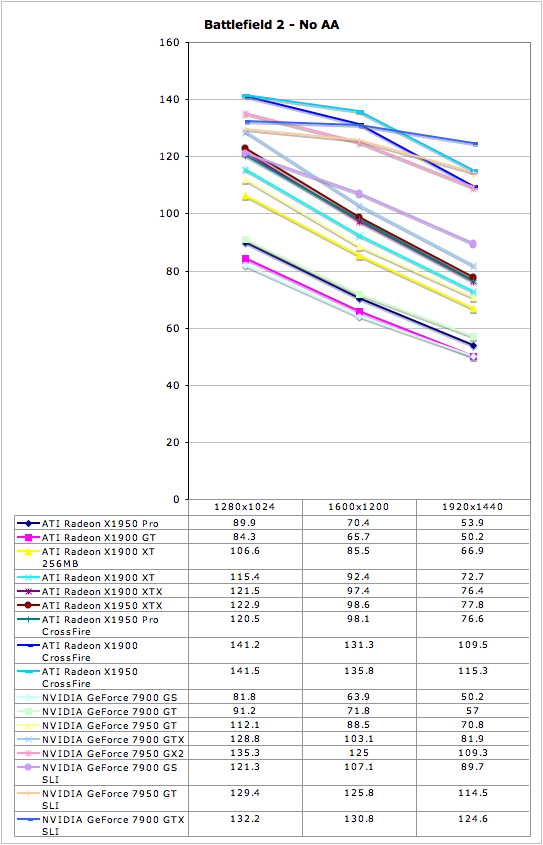
Its ability to offer 7900 GT levels of performance at the price of a 7900 GS makes the Radeon X1950 Pro quite a deal. The added memory speed gives the X1950 Pro a good advantage over the X1900 GT here. Of course, when the new handicapped X1900 GT comes along, expect this gap to widen. X1950 Pro CrossFire offers performance levels on par with X1900/X1950 XTX under BF2 without AA enabled. This puts it in competition with the 7900 GTX and offers much better performance than the 7950 GT. All what we would expect from $400 of graphics card. Interestingly, NVIDIA's 7900 GS SLI is able to offer better performance than X1950 Pro CrossFire in spite of the single card performance advantage the later maintains. This indicates that SLI scales much better than CrossFire under these conditions.
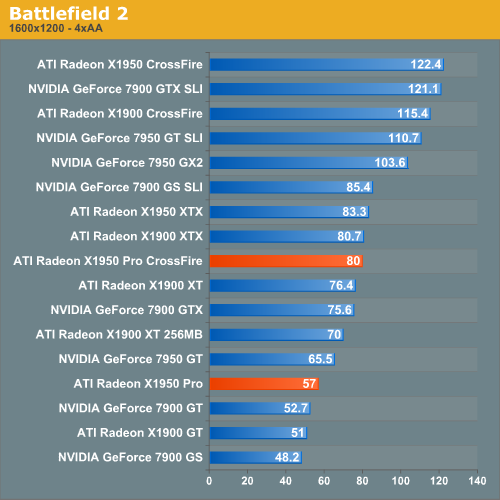
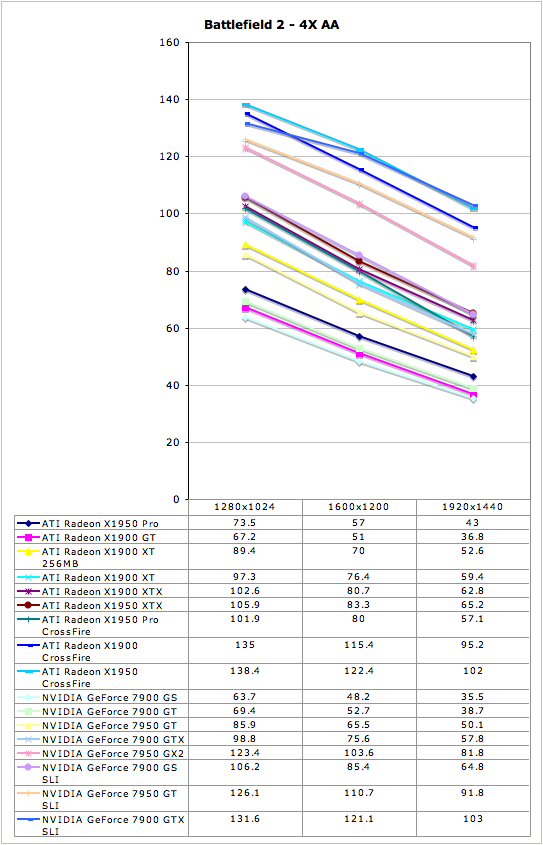
With 4xAA enabled, the X1950 Pro performs even better compared to the competition. CrossFire, however, doesn't give any more of a boost in comparison to X1900/X1950 XTX or 7900 GS SLI than we saw without AA. The X1950 Pro is an excellent choice as a single card solution, but for multi-GPU users, SLI is still a better bet.


 Facebook
 Twitter
 RSS
RSS


45 Comments
View All Comments
Zoomer - Thursday, October 19, 2006 - link
Is this a optical shrink to 80nm?Answering this question will put overclocking expectations in line. Generally, optically shrunk cores from TSMC overclock to the about the same as the original or perhaps slightly worse.
coldpower27 - Friday, October 20, 2006 - link
Well no as this piepline configuration doesn't exist natively before on the 90nm node. It's a 3 Quad Part, so it's basedon R580 but has 1 Quad Physical removed as well as being shrunk to 80nm. Not to mention Native Crossfire support was added onto the die.Spoelie - Friday, October 20, 2006 - link
Optical shrink, this is 80nm and the original was 90nm. You're normally correct because the first optical shrink usually does not have the same technologies as the proces higher up (low-k and SOI for example, this was the case with 130nm -> 110nm), but I don't think it's the case for this generation. Regardless, haven't seen any overclocking articles on it yet so I'm quite curious.Spoelie - Friday, October 20, 2006 - link
oie, maybe I should add that it's reworked as well, so both actually. Since this core didn't exist before (rv570 and that pipeline configuration), I don't think that they just sliced a part of the core...Zstream - Tuesday, October 17, 2006 - link
Beyond3D reported the spec change a month before anyone received the card. I think you need to do some FAQ checking on your opinions mate.All in all decent review but poor unknowledgeable opinions…
DerekWilson - Wednesday, October 18, 2006 - link
Just because ATI made the spec change public does not mean it is alright to change the specs of a product that has been shipping for 4 months.X1900 GT has been available since May 9 as a 575/1200 part.
The message we want to send isn't that ATI is trying to hide something, its that they shouldn't do the thing in the first place.
No matter how many times a company says it changed the specs of a product, when people search for reviews they're going to see plenty that have been written since May talking about the original X1900 GT.
Naming is already ambiguous enough. I stand by my opinion that having multiple versions of a product with the exact same name is a bad thing.
I'm sorry if I wasn't clear on this in the article. Please let me know if there's anything I can reword to help get my point across.
Zoomer - Thursday, October 19, 2006 - link
This is very common. Many vendors in the past have passed off 8500s that run at 250/250 instead of the stock 275/275, and don't label them as such.There are some Asus SKUs that have this same handicap, but I can't recall what models that were.
xsilver - Tuesday, October 17, 2006 - link
any word on what the new price for the x1900gt's will be now that the x1950pros are out?or are they being phased out and no price drop is being considered?
Wellsoul2 - Monday, November 6, 2006 - link
You guys are such cheerleaders..For a single card buy why would you get this?
Why would you buy the 1900GT even after the
1900XT 256MB came out?
I got my 1900XT 256MB for $240 shipped..
Except for power consumption it's a much better card.
You get to run Oblivion great with one card.
Two cards is such a scam. More expensive motherboard..power consumption etc.
This is progress? CPU's have evolved..
It's hard to even find a motherboard with 3 PCI slots..
What a scam! Where's my ultra-fast HDTV board for PCI Express?
Seriously..Why buy into SLI/Crossfire? Why not 2 GPU's on one card?
Too late..You all bought into it.
Sorry I am just so sick of the praise for this money-grab of SLI/Crossfire.
jcromano - Tuesday, October 17, 2006 - link
Are the power consumption numbers (98W idle, 181W load) for just the graphics card or are they total system power?Thanks in advance,
Jim