



GeForce 3D Vision: Stereoscopic 3D From NVIDIA
by Derek Wilson on January 8, 2009 2:30 PM EST- Posted in
- GPUs
As we've seen over the past few years, NVIDIA isn't content with simply doing what has been done well. Certainly their graphics cards are good at what they do and competition in the market is great today delivering amazing value to consumers. But they've forged ahead with initiatives like SLI for multi-GPU rendering and CUDA for general purpose programing on GPU. Now they're taking it a step further and getting into stereoscopic 3D.
To be fair, NVIDIA has supported stereoscopic 3D for a long time, but this is more of a push to get pervasive stereoscopic graphics into the consumer space. Not only will NVIDIA graphics cards support stereoscopic rendering, they will also be enhancing their driver to extract depth information and create left and right eye images for applications that do not natively produce or support stereo rendering. And did we mention they'll also be selling active wireless shutter glasses?
Packaged as GeForce 3D Vision, NVIDIA's shutter glasses and transmitter pair will run consumers a respectable $200. This is more expensive than some glasses and cheaper than others. We actually don't have any other glasses in house to compare them to, but the quality, freedom and battery life are quite good. If it becomes necessary, we will do a comparison with other products, but the real advantage isn't really in the hardware; it's in the driver. The package also comes with a soft bag and cloth for the glasses, alternate nose pieces, cables and converters, and a couple disks with drivers, stereoscopic photo viewer and video player.
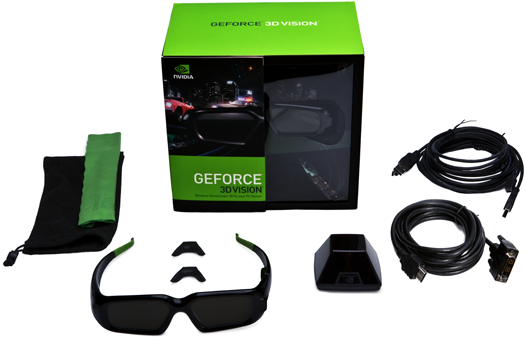
Stereoscopic 3D shutter glasses have been around since the late 90s, but with the push away from CRTs to LCDs with a fixed 60Hz refresh rate meant that high quality stereoscopic viewing on the desktop had to be put on hold (along with hopes for smaller pixels sizes, but that's a whole other rant). With Hollywood getting really interested in 3D movies and some display manufacturers getting on board with 120Hz monitors, TVs and projectors, it makes sense that we would see someone try to push this back to the forefront.
Before we get into just how NVIDIA wants to make stereoscopic 3D on the desktop a reality, lets take a look at exactly what we're talking about.


 Facebook
 Twitter
 RSS
RSS


54 Comments
View All Comments
roop452 - Wednesday, February 3, 2010 - link
Ashu Rege is coming this February to India's first and independent annual summit for the game development ecosystem - India Game Developer Summit (http://www.gamedevelopersummit.com/)">http://www.gamedevelopersummit.com/) to talk about the novel uses of GPU computing for solving a variety of problems in game computing including game physics, artificial intelligence, animation, post-processing effects and others.Webster4 - Wednesday, January 28, 2009 - link
SonicIce has left links that, according to WOT Firefox extension, redirect you to a malware website called jord.nm.ru. I wouldn't go there, especially if you're using IE. Just thought I'd warn you. There's nothing of interest in his links anyway in my opinion.has407 - Sunday, January 11, 2009 - link
If this is the chicken needed to to get us the eggs we need and increases stereo/3D adoption and support to critical mass, wonderful. However, a truly immersive experience--something that puts it beyond a novelty--is going to require much more, such as HMD's with decent resolutions, FOV, binocular overlap, etc. The price/performance/quality of those has improved significantly as OLED and related microdisplay technology advances, so we may be close... *IF* the game/app support is there. Unfortunately, I don't see much compelling about NVIDIA's offering, but if nothing else, they deserve an E for effort. IMHO I expect this will be at best a waypoint; in a couple years we'll have truly immersive HMD/VR systems that are affordable and will provide a compelling improvement in experience (again, IF the game/app support is there).quanta - Friday, January 9, 2009 - link
As I recalled, NVIDIA has made a lot of reference cards with stereoscopic outputs since the earlist Quadro. And who can forget all those ASUS TNT(2) cards that came with stereo glasses options? Considering that virtually ZERO game developers even care about making games using 3D glasses since the day of Descent, I fail to see how will NVIDIA suddenly able to convince game developers to make games that require people to by a $200 accessory on top of $400 video card for optimal experience. That kind of market is too small to be viable for any commercial game developers.Beoir - Friday, January 9, 2009 - link
I can understand NVIDIA wanting to branch out to the gamer in 3D rendering, but what I don't understand is why they don't leverage off of their strengths and do a Joint venture. What I'm getting at is this:1) NVIDIA is exceptional in creating Graphics rendering processing. Nvidia is not so good at developing physical Optical systems and understanding the Human Eye.
2)Vuzix is an expert in HUDs, and also has a viable (competitive) commercial HUD for watching movies. I speaking with a rep last year they were also interested in stereoscopic displays but could not pursue it since there was not a lot of market support or venture capital
These two guys sound like a great match to me. Toss in the fact that Vuzix is Rochester, NY where they have the University of Rochester institute of optics, and RIT's imagaing science center.
Have I painted a decent enough picture yet Nvidia? I can flowchart it out for the corporate suits if you like.
nubie - Friday, January 9, 2009 - link
This is what nVidia used to support:http://picasaweb.google.com/nubie07/3DMonitor#5057...">http://picasaweb.google.com/nubie07/3DMonitor#5057...
That is a picture of the driver panel from my nVidia drivers before they dropped support for real 3D.
I would love to spend $1000 on these glasses, and a new system, Vista, new video cards, and of course a new monitor to use them on.
I find this stupid because the quickest way to get this product a success is to appeal to people who have been vocal about their previous good 3D support, not pull the rug out from under these people with no warning, no comment, and no incentive.
quanta - Friday, January 9, 2009 - link
I believe you can still use it on Quadro (which NVIDIA still design video cards with stereo connectors). Just use the softquadro feature in RivaTuner to turn it on.nubie - Saturday, January 10, 2009 - link
I wish, and I don't need any stereo connectors for my dual polarized LCD display. Just dual outputs (vga or dvi, or one of each).I haven't been able to successfully soft-quadro my g92 or g80 card, and I don't think the drivers are for DirectX games anyway.
strikeback03 - Friday, January 9, 2009 - link
Actually, one of my friends does have to take dramamine before playing FPS games. And this is just with a PS3 and an LCD TV, no stereo anything.DerekWilson - Friday, January 9, 2009 - link
I believe Gary turned us all on to ginger root -- taking a good bit of it before playing Left 4 Dead with it's disorienting source engine FOV is the only way I can survive normally ... actually, you know what? I was able to play the game without taking anything with the glasses and I didn't even think of that til now. It seems the 3D Vision may have actually fixed my nausea with tight fov games ... I'll have to do some more testing to see if this pans out ...