



NVIDIA's Fermi: Architected for Tesla, 3 Billion Transistors in 2010
by Anand Lal Shimpi on September 30, 2009 12:00 AM EST- Posted in
- GPUs
ECC Support
AMD's Radeon HD 5870 can detect errors on the memory bus, but it can't correct them. The register file, L1 cache, L2 cache and DRAM all have full ECC support in Fermi. This is one of those Tesla-specific features.
Many Tesla customers won't even talk to NVIDIA about moving their algorithms to GPUs unless NVIDIA can deliver ECC support. The scale of their installations is so large that ECC is absolutely necessary (or at least perceived to be).
Unified 64-bit Memory Addressing
In previous architectures there was a different load instruction depending on the type of memory: local (per thread), shared (per group of threads) or global (per kernel). This created issues with pointers and generally made a mess that programmers had to clean up.
Fermi unifies the address space so that there's only one instruction and the address of the memory is what determines where it's stored. The lowest bits are for local memory, the next set is for shared and then the remainder of the address space is global.
The unified address space is apparently necessary to enable C++ support for NVIDIA GPUs, which Fermi is designed to do.
The other big change to memory addressability is in the size of the address space. G80 and GT200 had a 32-bit address space, but next year NVIDIA expects to see Tesla boards with over 4GB of GDDR5 on board. Fermi now supports 64-bit addresses but the chip can physically address 40-bits of memory, or 1TB. That should be enough for now.
Both the unified address space and 64-bit addressing are almost exclusively for the compute space at this point. Consumer graphics cards won't need more than 4GB of memory for at least another couple of years. These changes were painful for NVIDIA to implement, and ultimately contributed to Fermi's delay, but necessary in NVIDIA's eyes.
New ISA Changes Enable DX11, OpenCL and C++, Visual Studio Support
Now this is cool. NVIDIA is announcing Nexus (no, not the thing from Star Trek Generations) a visual studio plugin that enables hardware debugging for CUDA code in visual studio. You can treat the GPU like a CPU, step into functions, look at the state of the GPU all in visual studio with Nexus. This is a huge step forward for CUDA developers.
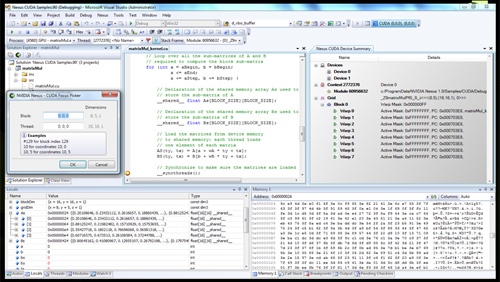
Nexus running in Visual Studio on a CUDA GPU
Simply enabling DX11 support is a big enough change for a GPU - AMD had to go through that with RV870. Fermi implements a wide set of changes to its ISA, primarily designed at enabling C++ support. Virtual functions, new/delete, try/catch are all parts of C++ and enabled on Fermi.


 Facebook
 Twitter
 RSS
RSS


415 Comments
View All Comments
Fortesting - Wednesday, October 7, 2009 - link
See this article:http://www.semiaccurate.com/2009/10/06/nvidia-kill...">http://www.semiaccurate.com/2009/10/06/...x260-aba...
Zool - Tuesday, October 6, 2009 - link
Maybe tesla cards in supercomputers which are closed platforms the cuda is better but for anything other commercial OpenCL will be better.This is a CUDA vs OpenCL test from Sisoftware http://www.sisoftware.net/index.html?dir=qa&lo...">http://www.sisoftware.net/index.html?di...ocation=...
The conclusion from that article : We see little reason to use proprietary frameworks like CUDA or STREAM once public drivers supporting OpenCL are released - unless there are features your code depends on that are not included yet; even then, they will most likely be available as extensions (similar to OpenGL) pretty soon.
It wouldnt be bad to see those kind of tests on anadtech. Something like GPUs vs CPUs tests with same code.
Zool - Monday, October 5, 2009 - link
I dont know how others, but the 8 time increase in DP which is one of the pr stunts doesnt seem too much if u dont compare it to the weak gt200 DP numbers. The 5870 has something over 500 GFlops DP and the gt200 had around 80 GFlops DP (but the quadro and tesla cards had higher shader clocks i think). They will be happy if they reach 1.5 times the radeon 5800 DP performance. In this pdf from nvidia site http://www.nvidia.com/content/PDF/fermi_white_pape...">http://www.nvidia.com/content/PDF/fermi...T.Halfhi... they write that the ECC will hawe a performance penalty from 5% to 20% (on tesla cards u will hawe the option to turn it off/on on GT cards it will be turned off).Zool - Monday, October 5, 2009 - link
I also want to add that if the DP has increased 8 times from gt200 than let we say around 650 Gflops, than if the DP is half of the SP (as they state) performance in Fermi than i get 1300 Gflops ???? (with same clock speeds). For GT200 they stated 933 Gflops. Something is wrong here maybe ?Zool - Monday, October 5, 2009 - link
Actualy they state 30 FMA ops per clock for 240 cuda cores in gt200 and 256 FMA ops per clock for 512 cuda cores in Fermi. Which means clock for clock and core for core they increased 4 times the DP performance.SymphonyX7 - Saturday, October 3, 2009 - link
Hi. I'm a long time Anandtech reader (roughly 4 years already). I registered yesterday just because I wanted to give SiliconDoc a piece of my mind but thankfully ended being up being rational and not replying anymore.Now that he's gone. I just want to know what you guys think of Fermi being another big chip. Is it safe to assume that Nvidia is losing more money than ATI on high-end models being sold simply because the GTX cards are much bigger than their ATI counterparts? Moreso now that the HD 58xx cards have been released which are faster overall than any of Nvidia's single-GPU solutions. Nvidia will be forced to further lower the price of their GTX cards. I'm still boggled as to why Nvidia would still cling to really big chips rather than go ATI's "efficiency" route. From what I'm reading, this card may focus more on professional applications rather than raw performance in games. Is it possible that this may simply be a technology demonstrator in the making in addition to something that will "reassure" the market to prevent them from going ATI? I don't know why they should differentiate this much if it's intended to compete with ATI's offerings, unless that isn't entirely their intention...
Nakomis - Saturday, October 3, 2009 - link
Boy can I tell you I really wish SilDoc was still here? Anyone have his email address? I wanted to send him this:http://rss.slashdot.org/~r/Slashdot/slashdot/~3/9J...">http://rss.slashdot.org/~r/Slashdot/sla...es-Fermi...
- Saturday, October 3, 2009 - link
There was no benchmark, not even a demo during the so-called demonstration! This is very pathetic and it looks that Nvidia wont even meet the december timeframe. To debug a chip that doesnt work properly might cost many months. To manufacture a chip another 12 weeks. To develop the infrastructure including drivers and card manufactures another few months. Therefore, late q12010 or even 6/2010 might become realistic for a true launch and not a paperlaunch. What we could see on this demonstration was no more than the paper launch of the paper launch.Nate0007 - Friday, October 9, 2009 - link
Hi, I fully agree with you 100%You seem to be one of very FEW people that actually see that or get it.
You know what i can not seem to understand ??
How can supposedly a few hundred or so of people that are knowlegable of what it is they are about too see or somewhat of why they are attending the demonstration just sit there and listen to 1 person standing up and make claims about his or a product but have no proof ?
I understand how things are suppose to be, but have we all just become so naive to just believe what is pushed onto us through media ( ie..TV,Radio.Blogs.Magazines.ect...) and just believe it all ?
I am not saying that what Jen Shun showed was NOT a real demo of a working Fermi Card , I am just saying that there was and still is NO proof of any sort from anyone that was able to actually confirm or denie that it actually was.
Untill Nvidia actually shows a working sample of Fermi , even a so called ruffor demo model of it so long as it actually real I will not believe it.
There is a huge difference between someone makeing claims on the forums of sites like this here and or Blogs and someone who is holding a news conference clainming what they have achieved .
Next thing you know someone will stand up and say they have discoverd how to time travel and then show a video of just that.
There is a difference be facts and reality.
bigboxes - Saturday, October 3, 2009 - link
RED ROOSTER! jk :pFWIW, I'm glad AT banned that fool. Too bad it took 37 pages of fanboi ranting for it to come to fruition. For those that cry that there is no place to discuss this AT does have a video forum that will not allow this kind of shenanigans. Does anyone wonder if this is Rollo back from the grave?