



Intel X25-M G2: Dissected and Performance Preview
by Anand Lal Shimpi on July 22, 2009 6:00 PM EST- Posted in
- Storage
Be sure to read our latest SSD article: The SSD Relapse for an updated look at the SSD market.
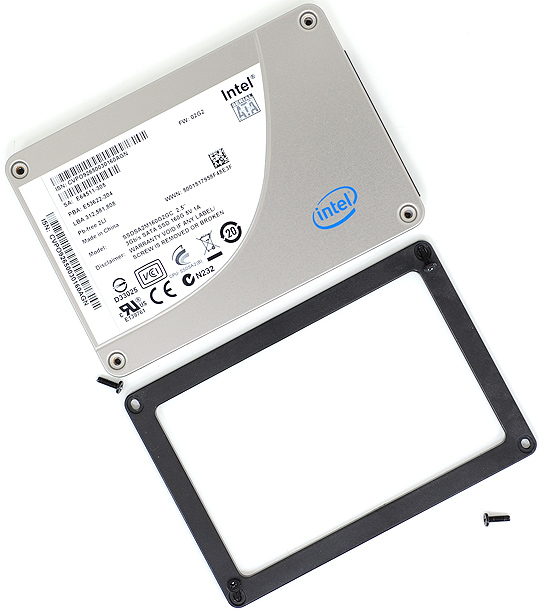
Earlier today the FedEx man dropped off a box with this in it:
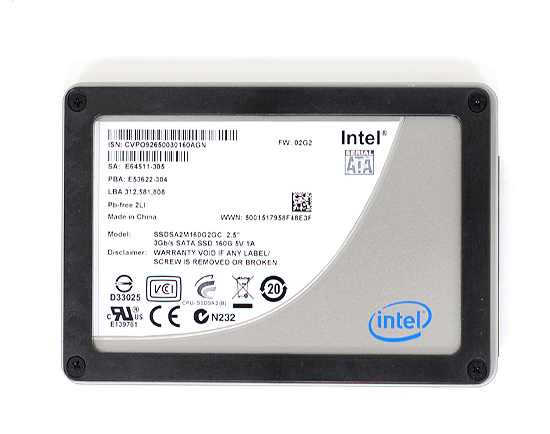
That's the new X25-M G2 I wrote about yesterday, which features a slightly improved controller and 34nm NAND flash. Im hard at work on a full review but I thought I'd share some preliminary data with you all.
As I mentioned yesterday, the new drive has a silver enclosure. Intel says the new enclosure is cheaper than the old black one:
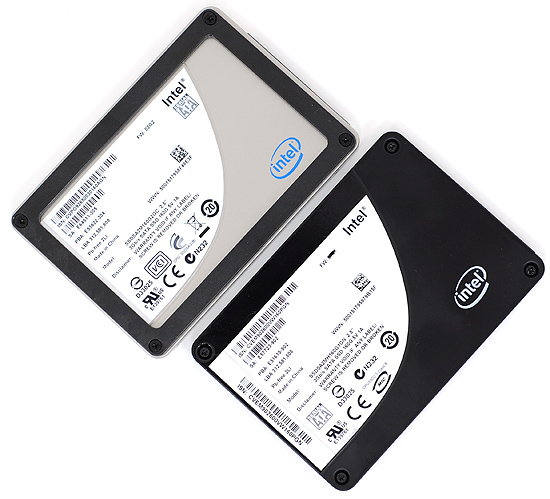
The X25-M G2 (top) vs. the X25-M G1 (bottom)
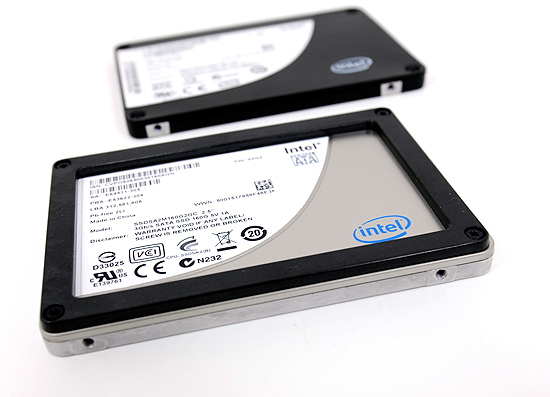
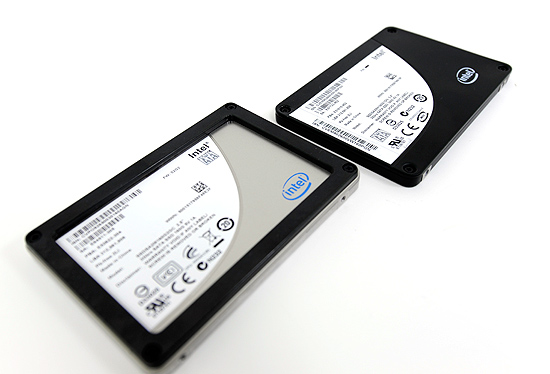
Our sample also shipped with a plastic spacer so the drive can be used in 9.5mm 2.5" bays as well as 7mm bays by removing the spacer.


 Facebook
 Twitter
 RSS
RSS


87 Comments
View All Comments
Bolas - Friday, August 21, 2009 - link
So... does it work yet?What's the current status of the G2 firmware bug? Any idea when we'll be able to buy G2 drives on Newegg?
krazyderek - Sunday, August 16, 2009 - link
I know this is a bit pre-emptive, but i really hope that if the introduction of TRIM goes well that we see a double bar graph showing new AND used performance bars for each drive (ie: TRIM on, TRIM off). Once TRIM is implemented it may level the playing field for some drives and that should be easily and fairly shown in the charts. I know you had shown used vs new benchmarks during the anthology but in different charts sometimes on different pages made it tricky to see exactly the difference. Again, if TRIM is all it's touted to be, "new" state may be, the longterm state of an SSD.Here's hoping Intel get's it act together with those seq writes.
PS, i own an 50nm 80gb intel, i'm semi ticked intel won't release a firware with TRIM in it, at the same time, it still has the second fastest random read and write (second only to it's newer version) and it feels rediculously fast to me launching every application on my computer at once when i start windows, and a sub 20 second boot time in OSX.
Alberto122 - Tuesday, August 4, 2009 - link
I think computer market will slowdown in the next two years. Industry results in July shows profit warnings and losses in many companies. Intel lost 398 US$ mill and AMD 335 US$ mill.New Google Chrome operating system (which has lesser hardware requirements than Windows), virtualization runing on multicore computers (one computer, many users) and financial crisis can hit very hard the sales for PC market.
Well see how can they sale new processors.
http://managersmagazine.com/index.php/2009/08/info...">http://managersmagazine.com/index.php/2...ctorial-...
krazyderek - Sunday, August 16, 2009 - link
Intel with it's high IOPS, and SSD's in general with their non-existent response time seem poised to dominate multi-user, and virtualization setup's. It does seem like hard times ahead, but that's where bang for buck is really going to count and not to many people actually "need" a 2TB drive, where as HD's have been the bottleneck in computer's ever since the GHZ race spread out into the multi-core arena. SSD's seems ready to stand up in a multi user server, or virtualization setup to take it from "hold on a second i'm on a shared server login" to.. "really, this is a shared computer?"jimhsu - Sunday, August 2, 2009 - link
Hey Anand, I think I finally found the Achilles Heel of the X25-M: Poor random read performances under a heavy seq write workload.http://www.hardforum.com/showpost.php?p=1034430137...">http://www.hardforum.com/showpost.php?p=1034430137...
Reproduce with:
PerformanceTest 7.0 (x64)
Advanced Disk Test
2 synchronous threads
500MB test files
Uncached Win32 API
Thread 1: 100% Read, 100% Random, 4096 byte block size
Thread 2a: 100% Write, 0% Random, 1 MB block size
Thread 2b: 100% Write, 100% Random, 4096 byte block size
In general, the X25-M lags HEAVILY when doing a seq write (e.g. file copy) while doing random reads (e.g. opening microsoft word). Heavy RANDOM writes are not a problem, suggesting possibly poor interleaving of large seq writes and small reads.
Worth discussing with Intel?
jimhsu - Saturday, August 15, 2009 - link
What makes this even harder to understand is that performance on the drive is dynamic - the algorithms gradually accommodate changing workloads under a fragmented condition. This only happens under LOW free space conditions in the used state.I copied a lot of files sequentially to the SSD these few days. Seq write speeds increased from 30-40MB/s to over 80MB/s these few days, but random writes dropped to 15MB/s. These are Crystaldiskmark benches so I don't trust them much at all, but seq writes definitely became faster (can't feel the effect of slower random writes).
The performance profile of these Intel drives is VERY confusing. TRIM will probably help a lot to make performance less confusing.
iwodo - Monday, August 10, 2009 - link
Interesting, does this problem exsist in other SSD drive from Samsung or Indilix?HexiumVII - Wednesday, July 29, 2009 - link
Do these new drives support it?Alkapwn - Sunday, July 26, 2009 - link
Came across this information, and wonder if there is any way to verify it. Anyone heard of drive problems on these new g2's?http://www.pugetsystems.com/blog/2009/07/24/minor-...">http://www.pugetsystems.com/blog/2009/07/24/minor-...
somedude1234 - Tuesday, July 28, 2009 - link
I ordered one from Puget last week. I can confirm that they are doing exactly as they said in the linked post and contacting people with pending orders directly.I fell into the category of "not likely to use a BIOS password on the drive, but willing to wait if Intel thought a hardware change was necessary".
Once they confirmed that a simple firmware update would resolve the issue, I gave them the go-ahead to ship mine. I should be receiving it soon.
So far I've been very impressed with the customer service at Puget Systems. They are definitely responsive to their customers.