



Apple iPad 2 Preview
by Anand Lal Shimpi, Brian Klug & Vivek Gowri on March 12, 2011 6:01 AM ESTThe second generation iPad went on sale earlier today, to much fanfare and long, long lines. We're hard at work on our full review of Apple's second generation tablet but there were a few things we wanted to chime in on before too much time passed.
The iPad 2 is a very logical update to the original iPad. The hardware gets an upgrade, with revised industrial design, a slimmer chassis, and Apple's new A5 SoC inside. A5 brings along two Cortex A9 cores, a dual core version of PowerVR's SGX543 graphics chip, and 512MB of memory. Software stays mostly the same but gets some tweaks; the iPad 2 ships with iOS 4.3, which was released earlier this week as an update for the iPhone 4 and original iPad.

The industrial design has changed pretty significantly, from the convex curvature of the original iPad's back to the flat back of the new iPad. Starting with the iPhone 4, Apple has been moving away from the continuous curvature that dominated their handhelds two or three years ago (think iPhone 3G/3G-S, iPod touch 2G/3G, and the 4G/5G iPod nano) and more towards a flatter and more rectangular design language across the board. The iPhone 4 is the only one that's really angular, but the 4th generation iPod touch debuted the same flatness with more ergonomically friendly curves. The iPad 2 basically carries the iPod touch 4G design language on a larger scale.
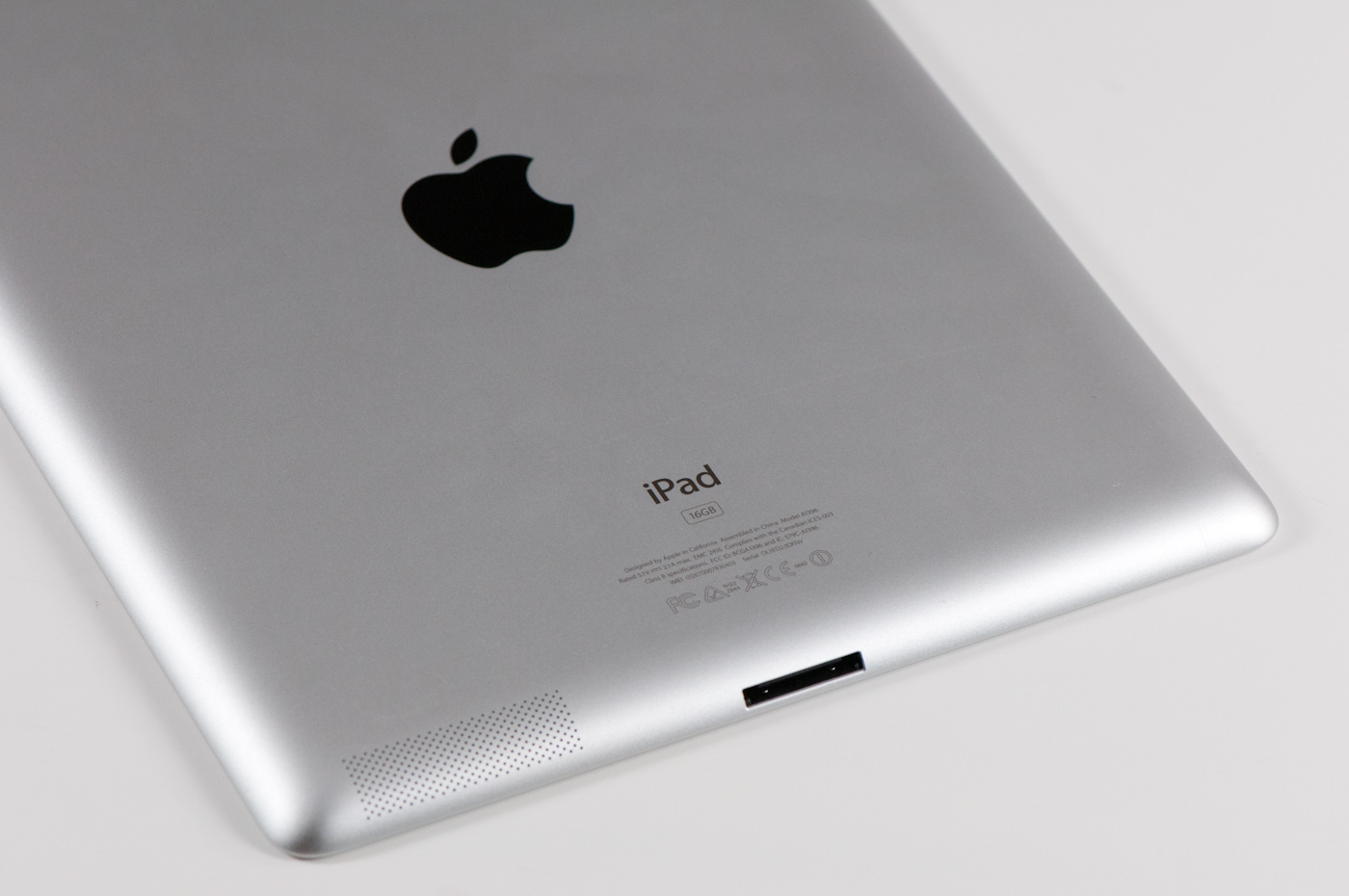
The iPad 2 is slightly lighter but easier to hold than the previous generation. Laying in bed and reading is probably where the difference becomes most apparent. The gentle curvature running around the edge makes the in-hand feel surprisingly different, as does the considerably thinner profile. I'm actually shocked at how dramatic the difference is.
The downside to the very large radius curvature on the outside is that the dock connector is now awkwardly exposed. It's very similar to how the iPod Touch looks, with about 2 mm of exposed connector visible viewed from the back.
The previous generation dock connector was the subject of constant criticism for being way too tight. Apple has over-corrected with the iPad 2 and now the dock connector is too loose. Just browsing the Apple store, I noted several units whose dock connectors appeared plugged in, but had come just loose enough to not charge.
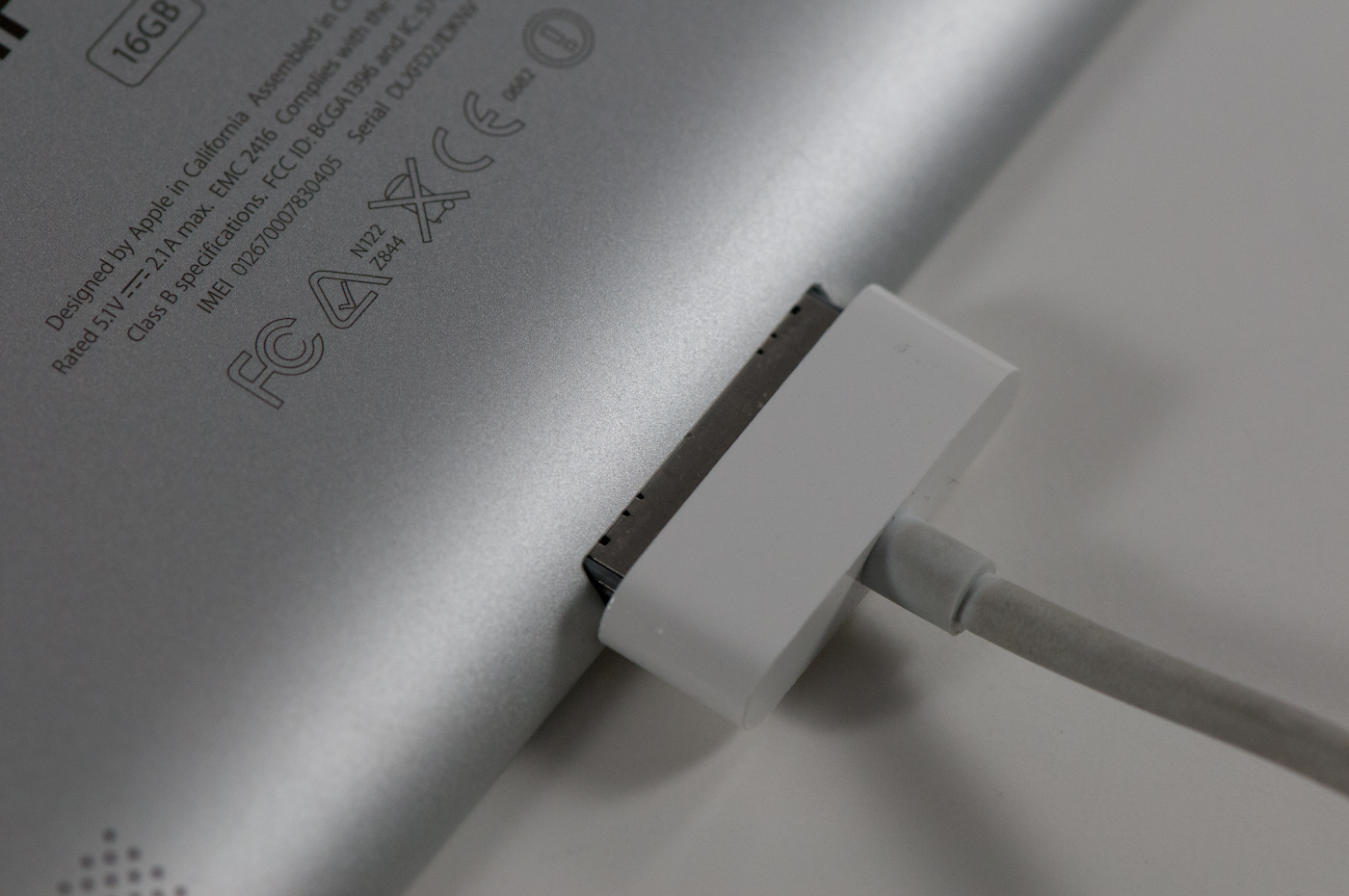
When connecting 30-pin dock cables, there's not too much resistance holding the cable in place, and the port itself is difficult to locate without flipping the thing over or viewing it from below.
Another welcome change - the return of the white iDevice. After the no-show that was the white iPhone 4, I was pleased to see Apple ship the white-bezeled iPad 2 on time with no production hitches. I was also wrong about how good white would look. Instead of being overwhelming or busy, the white bezel actually has one notable advantage over black - it doesn't show fingerprints or dust. That alone was what constantly drove me crazy about the previous generation - it always looked dirty. Shockingly, white seems to actually make sense.

Other hardware chances are the addition of front and rear facing cameras for FaceTime and taking pictures, but unfortunately, they seem to be pieces lifted from the iPod touch and nothing near the iPhone 4's 5 megapixel shooter. We'll talk about what this means for picture quality overall later on in the preview. The switch on the side can now be configured to either be a device silencer or a rotation lock switch, and there is now a large speaker on the bottom right corner of the device.
Overall, the new design really works - the iPad 2 feels good in hand, and instantly makes its predecessor feel a little clunky. But we didn't just pause our testing to talk about design, there's a lot under the hood of the iPad 2 that demands attention.


 Facebook
 Twitter
 RSS
RSS


82 Comments
View All Comments
Destiny - Saturday, March 12, 2011 - link
If Apple iPAD 2, NVIDIA's Tegra 2, TI's OMAP 4 and Samsung's Exynos all use the same Dual Core ARM Cortex A9... why are there performance differences shown in your testing and benchmarks of these products?StevoLincolnite - Saturday, March 12, 2011 - link
iPad uses iOS the others use variations of Android with who knows whats loaded in the background.But the simple reason is different OS's provide different performance characteristics as they handle processes and memory loads differently.
Destiny - Saturday, March 12, 2011 - link
Thank-you for the reply... now my knowledge and processor IQ just went up a notch... : )solgae1784 - Saturday, March 12, 2011 - link
Yep. All that hardware specs means nothing if your software can't utilize it. That much is clear even way back in the days.vol7ron - Saturday, March 12, 2011 - link
It's not just due to the OS, it is also due to the other hardware coupled with the A9. For instance, more RAM means application data can be loaded quicker, rather than from the HD. The GPU and screen size/resolution also effect benchmarks - the amount of effect depends on the type of test.Also the different hardware vendors may have modified some of the firmware instruction sets to make it more efficient.
But that's a big reason why these benchmarks are used, to have some sort of common ground that more accurately compares the different hardware/software combinations.
MonkeyPaw - Saturday, March 12, 2011 - link
We also don't know the clocks of the A5. Maybe it's not safe to assume it's running at 1.0ghz?Anand Lal Shimpi - Saturday, March 12, 2011 - link
Er you're very right about that. Geekbench reports 900MHz :)Take care,
Anand
tipoo - Saturday, March 12, 2011 - link
http://www.apple.com/ca/ipad/specs/Its 1GHz. Geekbench reports the instantaneous speed, so you'll hear different numbers from that depending on what it ramps its speed down to to save power.
dagamer34 - Saturday, March 12, 2011 - link
It's all about the OS at that point, just like how iOS 4.3 gives 2.5x increase in Javascript performance compared to iOS 4.0 even using the same original iPad.vol7ron - Saturday, March 12, 2011 - link
That isn't the OS, that's the JS engine. Both software, both different roles.