



Computex 2007: AMD's Barcelona and Other Products
by Gary Key on June 11, 2007 4:00 AM EST- Posted in
- Trade Shows
AMD's Barcelona: Why we haven't published benchmarks
A month ago we were able to present to you a rare look at AMD's forthcoming roadmap, detailing everything from new plans for the mobile space to giving a better idea of AMD's reasoning behind the ATI acquisition. We left that article with a positive and hopeful note for AMD:
"For a while we had lost confidence in AMD, like many of you had as well, and although AMD's position in the market hasn't changed we are more confident now that it can actually bounce back from this. Intel seemed to have the perfect roadmap with Conroe, Penryn and Nehalem all lined up back to back, and we saw little room for AMD to compete. Now, coming away from these meetings, we do believe that AMD may have a fighting chance. Over the coming months you'll begin to see why; it won't be an easy battle, but it will be one that will be fought with more than just price."
A strong roadmap alone does not make for a successful company; we need to see near term execution as well. For AMD, that means Barcelona has to be competitive. The interesting part of AMD's disclosures as of late is that as much information as AMD has given us about its roadmap for 2008, 2009 and beyond, we have little to no details about when we can expect Barcelona and how fast it will be.
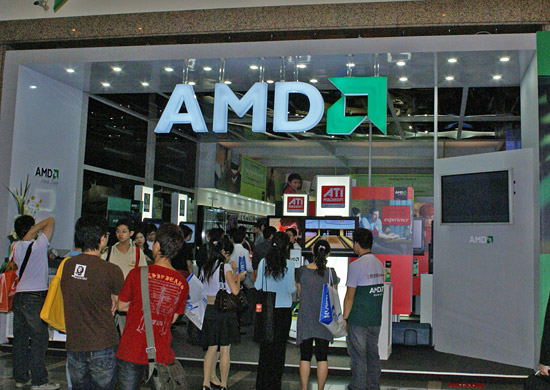
When we headed out to Taiwan, a country of leaked processors and benchmarking opportunities, for Computex we surely expected to return with some Barcelona performance figures. We were hoping we'd come back with the very data that AMD hadn't allowed us to get ourselves when we visited the company over a month ago. And while there were some performance results reported from Taiwan, there was an eerie silence about AMD's updated micro-architecture.
We were determined not to leave the island without running at least one test on Barcelona. We worked long and hard, and we were finally able to spend some time alone with Barcelona in Taiwan. But the story doesn't end there; it's unfortunately not that simple.
Motherboard Problems
We know that Barcelona works and runs benchmarks, as we saw back at AMD in May. But the demos that AMD ran were on its own motherboards, not on motherboards from its partners. AMD's partners just recently received their first "production quality" Barcelona samples, and as expected, the current boards required some heavy BIOS work before the new chips would even work, much less perform up to the expectations set by AMD.
The motherboard we tested on had minimal HT functionality and wouldn't run at memory speeds faster than DDR2-667; most 3D video cards wouldn't even work in the motherboard. Memory performance was just atrocious on the system, but the motherboard manufacturers we worked with attributed this to BIOS tuning issues that should be fixed in the very near future.
In the end, performance was absolutely terrible. We're beginning to understand why AMD didn't let us test Barcelona last month. It's not that AMD is waiting to surprise Intel; it's that the platform just isn't ready for production yet.
A month ago we were able to present to you a rare look at AMD's forthcoming roadmap, detailing everything from new plans for the mobile space to giving a better idea of AMD's reasoning behind the ATI acquisition. We left that article with a positive and hopeful note for AMD:
"For a while we had lost confidence in AMD, like many of you had as well, and although AMD's position in the market hasn't changed we are more confident now that it can actually bounce back from this. Intel seemed to have the perfect roadmap with Conroe, Penryn and Nehalem all lined up back to back, and we saw little room for AMD to compete. Now, coming away from these meetings, we do believe that AMD may have a fighting chance. Over the coming months you'll begin to see why; it won't be an easy battle, but it will be one that will be fought with more than just price."
A strong roadmap alone does not make for a successful company; we need to see near term execution as well. For AMD, that means Barcelona has to be competitive. The interesting part of AMD's disclosures as of late is that as much information as AMD has given us about its roadmap for 2008, 2009 and beyond, we have little to no details about when we can expect Barcelona and how fast it will be.
When we headed out to Taiwan, a country of leaked processors and benchmarking opportunities, for Computex we surely expected to return with some Barcelona performance figures. We were hoping we'd come back with the very data that AMD hadn't allowed us to get ourselves when we visited the company over a month ago. And while there were some performance results reported from Taiwan, there was an eerie silence about AMD's updated micro-architecture.
We were determined not to leave the island without running at least one test on Barcelona. We worked long and hard, and we were finally able to spend some time alone with Barcelona in Taiwan. But the story doesn't end there; it's unfortunately not that simple.
Motherboard Problems
We know that Barcelona works and runs benchmarks, as we saw back at AMD in May. But the demos that AMD ran were on its own motherboards, not on motherboards from its partners. AMD's partners just recently received their first "production quality" Barcelona samples, and as expected, the current boards required some heavy BIOS work before the new chips would even work, much less perform up to the expectations set by AMD.
The motherboard we tested on had minimal HT functionality and wouldn't run at memory speeds faster than DDR2-667; most 3D video cards wouldn't even work in the motherboard. Memory performance was just atrocious on the system, but the motherboard manufacturers we worked with attributed this to BIOS tuning issues that should be fixed in the very near future.
In the end, performance was absolutely terrible. We're beginning to understand why AMD didn't let us test Barcelona last month. It's not that AMD is waiting to surprise Intel; it's that the platform just isn't ready for production yet.


 Facebook
 Twitter
 RSS
RSS


64 Comments
View All Comments
Frags - Saturday, June 23, 2007 - link
I hope AMD succeeds in Barcelona so I can get another Intel Quad processor for cheap. All this debate is rather comical. In theory and on paper Barcelona looks like the cream of the crop, but as of yet, AMD has not shown me anything but a pretty FLASH presentation of hopes for the future. (Now a much MORE distant furture.) No Benchmarks or finalized product. They sure can Market though. Too bad there's nothing to sell.Emryse - Monday, June 11, 2007 - link
I can't express how dissappointing it is to see AMD in a bad way like this. It is true that according to current market trends, standards, and production - they're behind the curve, and there's just no getting around that.I see their potential - a road map that could culturally change the way a PC is built; we need that kind of innovation in the long run and AMD could pull it off, because they've done it before.
However, that's as I said in the long run. For now, they're not achieving measured goals that can reflect the capability, competence, and trust invested by their own employees, management, and investors to accomplish goals in a timely, budget-effective process. While it may not be so important that Barcelona succeeds in the short term, (and I say that because Intel has thoroughly trounced over anything AMD will offer in this segment) these concepts are absolutely vital as AMD continues to explore systems that offer CPU / GPU capabilities on the same platform - or even upgradeable modules to the CPU / GPU for task-specific application. While revolutionary in concept, these are objectives that require a sustained, driven, and highly focused effort to achieve the dramatic results that would be needed to bring AMD back into the arena.
What is difficult about the current situation remains the fact that company sustinance often exists in the court of public opinion (especially if it's publicly traded) - and AMD is only a few blows away from full-on "knock out". Intel is poised at the jugular, to be clear; worst-case scenario would be for (and this is very likely) Intel's '08 lineup to be introduced at the same time Barcelona releases (soft or hard).
Now let me be clear: this doesn not mean AMD sinks. What it DOES indicate is that Intel will probably continue to be the leader for the next few years (at minimum).
TA152H - Monday, June 11, 2007 - link
Good grief, stop being so melodramatic.Intel's '08 lineup is nothing. Penryn is nothing to worry about, it's a minor change and not as substantial as the Barcelona. I don't know why people exaggerate it so much, but I guess the uninformed make things up rather than deal with the complexities that not every change is the same in magnitude.
AMD has been in way worse situations than this, and they are still here. I think the real issues come back to Hector Ruiz. This ass-clown has to go. He just has to. He's earning massive amounts of money while leading the company into the abyss. That's my real concern, not some small delay in Barcelona performance, but this piece of crap CEO that is screwing everything up. Maybe this demise will be a blessing if they dump this sorry sack of dung. He's killing the company.
CobraT1 - Tuesday, June 12, 2007 - link
"Intel's '08 lineup is nothing." Compared to what? AMD's line up? Can you tell me what that will be?"Penryn is nothing to worry about" Who is worrying, well, other than AMD? Not you or I.
"it's a minor change and not as substantial as the Barcelona. I don't know why people exaggerate it so much, but I guess the uninformed make things up rather than deal with the complexities that not every change is the same in magnitude."
Ok, ok. I'm not trying to nitpick but c'mon. Melodramatic? Yes, Penryn is as Intel intended, an architectural update with some enhancements, a die shrink and additional performance. No big deal being made there. But c'mon, the only thing substantial about Barcy is that it is a major update for AMD. From a functional, performance or financial standpoint there is nothing substantial. It has yet to prove itself, at all. It in no was has had any significant impact other than to speculators. I have no idea why people pawn all over something they themselves know little to nothing about. I guess it called faith.
TA152H - Tuesday, June 12, 2007 - link
Are you crazy?Barcelona is a very big change compared to existing processors. And there is a lot known about it, just you don't. We know all about the new communications, the new branching, the L3 cache, the non-speculative memory reordering (the biggest thing, probably), inter processor communication (unlike Intel's FSB between the two sets of cores), additional HT link, SSE128, double instruction bandwidth, etc...
You are obviously uninformed, badly so, and assume there isn't a lot of information out there. They all add up to a pretty significant, although not revolutionary, upgrade to an existing product that isn't terrible. You need to learn more before making such a post, because it just comes off as uninformed.
I do agree with one thing though, we do have to wait until we see the results. But, to some extent, if I drop a rock from a tree, I don't have to watch it fall to know it will. This isn't that absolute, but the changes are so predictable it's hard to believe this won't be at least a very competitive processor. But, I'll agree, we won't know exactly how competitive until it actually is ready.
Emryse - Friday, June 15, 2007 - link
Quite frankly - I just thought you may wish to know that the tone of your posts thus far have been perceived by myself to be arrogant, cock-sure, egotistical, and disrespectful. I think you would do well to adjust the “attitude” of your future posts, as it would prevent me (as well as other readers I’m sure) from needing to pause every 4 seconds, stop concentrating on your actual message, and attempt to sift out your emotional baggage from the occasionally relevant fact or point (too few or far between, unfortunately).That being said – I’m not going to spend time sorting point vs. counterpoint to your objections raised. I will simply state that it would be impossible for anyone to read all of the above posts and not come away with the belief that you’ve contradicted yourself on more than one occasion.
We have seen very recent examples of supposedly “predictable” (the term you used) changes or innovations in architecture and performance for AMD, which in the final release did not even see the light of day. We’ve also seen efforts to correct inherent flaws in the design with additional hardware component modifications, additions, or even the occasional software driver revision where said “innovations” did occur.
AMD is now a CPU and GPU industry provider; ultimately under the same management, and currently in the process of being aligned to the same overall business strategy. I don’t need to be the most technically knowledgeable person on this form to understand that AMD is not in a good position right now.
Your posts seem to indicate a belief in the performance of this “holy grail” of an AMD chip, the revered Barcelona, as being the winning stroke that sends AMD back to the top in the server sector, and perhaps on a more global scale (which couldn’t be further from being the case in actual reality).
I and others are simply attempting to examine what we feel to be potentially more significant factors than the simple success or failure of a single chip. Actually, we’re interested in discussing the factors that would actually determine the success or failure of the chip in question – a discussion which apparently is lost on you.
My post did not claim to be “the most correct gospel on AMD as they stand” (as did every post you have ever made since). My post did cite my simple opinion, while allowing me to enjoy the feedback and insight of others in this forum (as was not the case with every post you have ever made since).
In all reality, I really think you should consider working for AMD so you can actually get paid for all of the promoting you’re doing on behalf of their up-and-coming product. Then again, considering your appeal with the consumer market represented here - I’m not so sure they would be interested.
Do I think AMD has a lot of potential? Absolutely! Do I fear for their current and future success? Yes; if they don’t start making some dramatic changes to their strategy as a whole. Am I hoping they will be successful? I most certainly am. Do your posts irritate me? That was a rhetorical question.
CobraT1 - Tuesday, June 12, 2007 - link
Are you crazy?Not really crazy, just well, not extreme.
Barcelona is a very big change compared to existing processors. And there is a lot known about it, just you don't. We know all about the new communications, the new branching, the L3 cache, the non-speculative memory reordering (the biggest thing, probably), inter processor communication (unlike Intel's FSB between the two sets of cores), additional HT link, SSE128, double instruction bandwidth, etc...
Oh, I think I might known a little bit. And it appears that you do as well, at least what the press reports tell you. It's easy to copy and paste isn't it. And what does all that mean to the market place, the consumer, to AMD's bottom line? Nothing. It is all unproven and just talk. Talk that the closer we get to AMD launch schedules the shakier their execution ability appears.
It's funny how you bang on Intel FSB, SSE, cache usage etc... yet these are features you tout with AMD. Does hypocrite come to mind? Yes, these features should be mention when discussing BOTH processor as these are some of the features that improve performance if done properly. Just because the parts are there doesn't mean they will work together. Proper design and integration is what we waiting to find out.
You are obviously uninformed, badly so, and assume there isn't a lot of information out there. They all add up to a pretty significant, although not revolutionary, upgrade to an existing product that isn't terrible. You need to learn more before making such a post, because it just comes off as uninformed.
Really what part? Or should I say parts, as you seem to believe you really have the market cornered on microprocessor design. Go ahead, pick them out and educate me, please go ahead.
I do agree with one thing though, we do have to wait until we see the results. But, to some extent, if I drop a rock from a tree, I don't have to watch it fall to know it will. This isn't that absolute, but the changes are so predictable it's hard to believe this won't be at least a very competitive processor. But, I'll agree, we won't know exactly how competitive until it actually is ready.
Hmmm, and after all your harping and insinuations that we are all idiots, you end with that? You agree we have to wait and see how competitive Barcy is. I'm sorry, but that's ****.
defter - Tuesday, June 12, 2007 - link
I don't know what is your definition about minor change, but Penryn will offer at least 5-10% higher IPC with at least 15-20% higher clockspeed. Thus Penryn will bring about 20-30% improvement compared to current Conroe which is quite substantial in my opinion.
TA152H - Tuesday, June 12, 2007 - link
None of the changes to Penryn were for clock speed, and your 5-10% is a made up number. If you see anywhere close to this, you'll only get it from the larger cache, which again is NOT architecture. The actual architecture changes are very minor, and not even in the same ballpark as the Barcelona. The problem is when people talk about it like it's a lot more than a die shrink (which allows for the larger cache, and possibly greater clock speeds), which it isn't. Even Intel doesn't categorize it as such, just a die shrink with some minor tweaks. Their bigger changes will come after this.Penryn clocking higher isn't clear either. They will release it at higher clock speeds, but the Conroe could be sold at much higher clock speeds if Intel wanted to. They just haven't seen much need to. So, if Penryn peaks at 3.6 GHz, I'm not sure that shows any progress in clock speed since getting a Conroe there is not difficult. I'll be curious to see how well it overclocks to see if it can hit over 4.4 GHz which would represent something close to a 20% increase in the real frequency limitation. The released numbers will be way higher, mainly because AMD's chips will be so much more competitive, they can't dog them with artificially low clock speeds.
defter - Tuesday, June 12, 2007 - link
No it's not. See Anandtech article about Penryn benchmarks, in some cases clock-to-clock improvement is much higher.
Who cares? Customers care about performance, it's irrelevant wherever the performance is achieved by larger cache, higher clockspeeds or some other changes. Penryn will produce substantial performance improvements compared to Conroe.
I seriously doubt that Intel could release quad core 65nm at above 3GHz with a reasonable TDP. Penryn based quad core CPUs should easily achieve higher clockspeeds.